


CARTAGENA, Colombia - The Development Bank of Latin America and the Caribbean (CAF) says it will invest US$10 billion through 2031 to finance projects that advance regional integration across Latin America and the Caribbean.
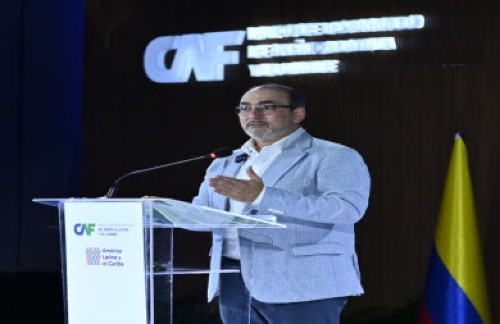 CAF Executive President, Sergio Díaz-Granados addressing the International Forum on Regional Integration in Cartagena, Colombia (CAF Photo)“Regional integration has already achieved important progress, but it must now enter a more ambitious phase of implementation. Fewer barriers, more infrastructure. Fewer diagnoses, more projects,” said CAF executive president, Sergio Diaz-Granados.
The CAF said that the resources will support strategic sectors including physical and digital infrastructure, intra-regional trade, food security, energy, tourism, innovation, logistics, and mobility, helping to strengthen connectivity, reduce development gaps, and improve the region’s competitiveness in an increasingly complex global environment.
CAF said that the investment reflects its continued commitment to regional integration as a driver of sustainable development, economic growth, and resilience.
CAF will support initiatives that strengthen value chains, advance the energy transition, improve food security, facilitate trade, and create greater opportunities for people and businesses across the region.
Díaz-Granados, made the announcement following the high-level discussions at the International Forum on Regional Integration that brought together government leaders, multilateral institutions, private sector representatives, academics, and development partners to discuss practical pathways for advancing integration in Latin America and the Caribbean.
Governor of the Eastern Caribbean Central Bank ECCB), Timothy Antoine; Ambassador Wayne McCook, Assistant Secretary-General of CARICOM; Ian Durant, Director of Economics at the Caribbean Development Bank (CDB), Martín Portillo, chief engagement manager for Central America and Dominican Republic at CCRIF, and Natalie McGuire, curator at the Barbados Museum & Historical Society, were among Caribbean delegates at the forum.
Díaz-Granados described the focus on integration as “a development, competitiveness, and global positioning imperative for Latin America and the Caribbean”.
In a context marked by geopolitical tensions, trade fragmentation, financial volatility, and a new era of uncertainty, he noted that countries across the region must deepen regional integration if they are to play a greater role in global value chains, advance the energy transition, strengthen food security, and adapt to a changing global production landscape.
“Integration is the answer to protecting our strategic ecosystems, creating jobs, addressing informality, and defending the democratic values that underpin our coexistence, freedom, and future,” he said.
Within the framework of the forum, 15 regional institutions signed on to the “Declaration on the Convergence of the Processes and Mechanisms of Integration of Latin America and the Caribbean.”
The declaration proposes moving towards an active and intelligent convergence of the various integration processes and mechanisms existing in the region. This approach seeks to coordinate capabilities, priorities, and lessons learned to avoid duplication, enhance synergies, and align strategic agendas.
Among the 15 signatories to the declaration were the Economic Commission for Latin America and the Caribbean (ECLAC), Amazon Cooperation Treaty Organization (OTCA), the Organization of Ibero-American States (OEI), the Latin American Energy Organization (OLADE), and others.
Over the last 30 years, CAF has approved 118 credit operations totalling US$ 16.73 billion for regional integration initiatives.

