


BRIDGETOWN, Barbados – The Barbados’ economy continued to expand during the first half of 2026, with domestic sectors again leading the growth with real gross domestic product (GDP) growing by an estimated 1.4 per cent,” the Governor of the Central Bank of Barbados (CBB), Dr. Kevin Greenidge said Thursday.
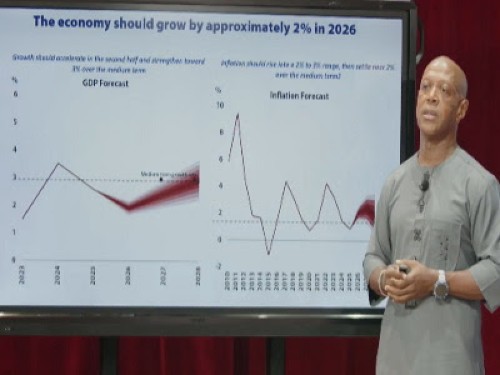 Governor of the Central Bank of Barbados (CBB), Dr. Kevin Greenidge reviewing the local economy over the past six months (CMC Photo)The Central Bank says it expects the local economy to grow by approximately two per cent in 2026, at the lower end of the two to three per cent range published at the end of the first quarter.
It said that growth of 1.4 per cent in the first half came in below the pace that range assumed. Tourism, construction, and transportation each fell short of projection, and together they account for the difference.
The CBB said that external conditions weighed on activity during the first half, with the effects concentrated in the second quarter. The war in the Middle East raised freight and energy costs, disrupted shipping routes, and lifted the cost of capital.
“Sharply higher airfares and reduced seat capacity weighed on the United States market in particular, and long-stay arrivals held broadly level rather than expanding as projected,” the CBB said, noting that reaching approximately two per cent for the year requires second -half output to expand by approximately 2.5 per cent relative to the second half of 2025.
In a review of the Barbados economy over the first six months of this year, Greenidge said that the non-traded sector expanded by 1.5 per cent and that business and other services drove that expansion, with wholesale and retail trade also contributing and construction recording modest growth.
He said that the traded sector also expanded by 0.4 per cent and tourism value added, which accounts for about half of traded output, remained close to its level a year earlier.
According to the Central Bank Governor, long-stay arrivals edged higher, but shorter average stays reduced visitor nights.
“Agriculture added to growth, while manufacturing output remained broadly unchanged. Domestic activity therefore sustained overall economic growth in a more challenging global environment marked by heightened geopolitical tensions, trade uncertainty, and softer demand in several key tourism source markets.”
Greenidge said that labour market indicators remained broadly favourable, while inflation rose from a low base but remained contained. He said the unemployment rate stood at 6.1 per cent at end -March 2026, approximately 0.2 percentage points below its level a year earlier, and unemployment claims fell by 3.7 per cent during January to June.
“The labour force also contracted by 2,700 persons as the number of retirees increased, so the lower unemployment rate reflected both a reduction in the number of unemployed persons and lower labour force participation.”
Greenidge said that the 2-month moving average inflation rate reached 1.4 per cent, while point-to-point inflation rose to two per cent in May 2026, as higher prices for food, education, housing and utilities, and transport pushed the rate up.
He said government policy measures continued to cushion the domestic pass-through of external cost pressures.
The Central Bank said Barbados maintained strong external buffers, reinforcing its resilience to external shocks. It said international reserves increased by BDS$91.8 million (One BDS$=US$0.50 cents) from the end of December 2025 to BDS$3.1 billion, equivalent to 25.9 weeks of import cover and comfortably above the internationally accepted adequacy benchmark.
It said that the current account deficit narrowed to BDS$189.4 million, as stronger net current transfers and a narrower income deficit more than offset a wider merchandise trade deficit and a smaller services surplus.
Greenidge said that the government comfortably exceeded its first primary balance floor under the Barbados Economic Recovery and Transformation (BERT) 2026 programme. He said that the overall fiscal surplus reached BDS$347.4 million and the primary surplus BDS$537.5 million at the end of June 2026, with the primary surplus BDS$353.5 million above the programme floor.
He said government preserved substantial surpluses while increasing spending on goods and services, public institutions, and capital projects. Although both surpluses narrowed relative to the corresponding period of the financial year 2025/26, the primary surplus remained well above the programme floor.
“Sustained primary surpluses and continued economic growth kept public debt on its downward trajectory. Gross public sector debt stood at BDS$15.1 billion at the end of June 2026, $250.8 million below the ceiling set under the BERT 2026 programme,” Greenidge said, adding that the debt -to-GDP ratio declined by 1.1 percentage point to 93.7 per cent, from 94.8 per cent at the end of the financial year 2025/26.
The Central Bank Governor said that the priority for the remainder of this year is to translate this stability into stronger traded -sector performance.
“These buffers provide the platform, but broadening the base of growth and supporting the full-year outlook will require faster execution of major investment projects, higher productivity, and improved export competitiveness.”
He said that the forward indicators support an acceleration of that order. IN the tourism sector, forward bookings for the July to December period stand approximately 3.7 per cent ahead of the same period of 2025, with the United Kingdom pacing 10 per cent ahead and Caribbean and European markets also higher, while the United States market remains slightly behind.
Greenidge said planned seat capacity for July to December stands three per cent above the corresponding period of 2025, with increases of 13 per cent from Canada, nine per cent from the United Kingdom and Ireland, and five per cent from both Europe and the Caribbean, partly offset by an eight per cent decline from the United States.
He said ongoing work at the Pierhead Development, Coverley Residences, Atlantic Breeze, and Vistara Residences, together with the planned start of several new projects such as One Carlisle and the Afreximbank Trade Centre, should strengthen construction activity during the second half.
“The resulting increase in investment should support business and other services, wholesale and retail trade, transportation, and employment. Improved rainfall and the Ministry of Agriculture, Food and Nutritional Security’s crop escalation programme should also support selected food crops, although weather conditions, planting decisions, and the availability of quality planting material remain risks.”
But the Central Bank Governor says external pressures nevertheless temper the pace of that recovery. He said freight, energy, and capital costs remain elevated, and further softening in the United States market or slower delivery of planned investment would hold the acceleration below the level this projection assumes.
Greenidge said that the global outlook remains subject to elevated uncertainty amid persistent geopolitical tensions and trade policy shifts. The International Monetary Fund’s (IMF) July 2026 World Economic Outlook projects global growth of three per cent in 2026 before recovering to 3.4 per cent in 2027. \
“For Barbados, external developments influence economic activity through tourism demand, commodity prices, freight costs, and supply chain reliability. A further escalation in geopolitical tensions or trade restrictions could weaken external demand for tourism, raise imported costs, disrupt supply chains, dampen business confidence and investment, and increase uncertainty around external financing.”
Greenidge said that domestic inflation should rise modestly as global input costs strengthen, although targeted government measures should contain the pass -through. He said that the CBB projects the 12 -month moving average inflation rate within a range of two to three per cent in the near term.
“Higher food, energy, and freight costs create the upward pressure. Targeted government measures should limit the domestic effect, particularly on energy prices. Further geopolitical escalation presents the main upside risk to this projection,” Greenidge said, noting that tourism earnings and other external inflows should keep international reserves strong and adequate.
“The first-half increase in current transfers reflected corporate tax receipts, including flows associated with the global minimum tax regime, which may not recur at the same pace. Higher fuel imports, weaker tourism demand, delays to investment inflows, and geopolitical disruption present the principal risks to the external position.”
Greenidge said BERT 2026 and the precautionary IMF Stand -By Arrangement provide a framework for maintaining fiscal discipline, protecting external buffers, and advancing reforms that support investment and productivity.
“The arrangement offers insurance against external shocks without drawing on Fund resources, while the programme anchors the primary balance path required to continue reducing public debt. Continued progress on tax administration and public sector governance reforms should support that path.
“Continued economic growth should support lending and asset quality, while strong capital and liquidity protect the system against shocks. Improvements in borrower repayment performance should preserve loan quality, and capital and liquidity positions provide the capacity to absorb shocks,” Greenidge said, adding that the recent rollout of BiMPay, the national instant payment system launched in June, should improve payment efficiency, broaden access to electronic payments, and support financial inclusion over time.
“Strong buffers give Barbados the capacity to withstand shocks, but the full -year growth outcome will depend on faster investment execution, stronger productivity, and improved traded -sector performance. Prudent fiscal management and the timely delivery of public and private investments will determine how much of the projected acceleration materialises,’ Greenidge added.

