


WASHINGTON, DC - A survey by the Inter-American Development Bank (IDB) has found that employment quality in Latin America and the Caribbean reached its highest level in 2024, surpassing pre-pandemic levels for the first time.
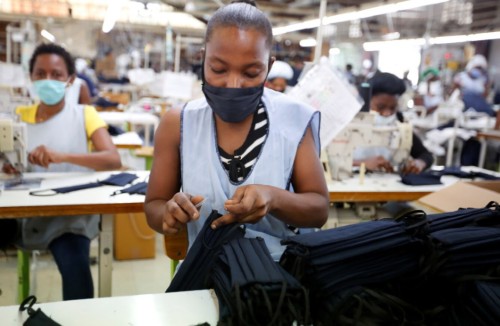 Women work at a garment factory in Latin America and the Caribbean“Latin America and the Caribbean has made important progress in employment quality and job creation, but not necessarily in transforming jobs. The record level we see today also shows how much remains to be done,” said Oliver Azuara, Labour Market specialist of the IDB.
“Half of the region’s workers continue to be in informal employment and earn incomes that do not allow them to escape poverty,” he added.
But despite the improvement, the region still faces significant challenges with seven in 10 workers do not contribute to social security, and young people face greater difficulties in accessing good jobs.
These are the main findings of the 2026 edition of the “Better Jobs Index,” produced by the IDB’s Labour Observatory and which analysed labour market trends across 17 countries using data from 2010 to 2024.
The regional Better Jobs Index increased from 54.9 to 58 points between 2010 and 2024, driven primarily by improvements in income. The indicator measuring whether wages are sufficient to keep workers out of poverty rose from just over 40 points to more than 50 during this period.
The indicator measuring employment quantity remained stable at 75.4 points. Despite these gains, progress in job quality remains insufficient, at just 40.6 points out of 100: informality stood at 69 per cent, and approximately half of the working-age population still faced labor poverty.
The improvement in quality was driven largely by rising labour income. The living-wage adequacy indicator increased from just over 40 points in 2010 to more than 50 in 2024. Formality also improved, but at a much slower pace, rising from approximately 27 to nearly 31 points over the same period.
The study, which presents the latest data from the index, analyses labour market trends in 18 Latin American and Caribbean countries between 2010 and 2024 across two dimensions namely employment quantity, measured through labour force participation and employment rates and employment quality, measured through formality and living-wage adequacy.
The Index measures, on a scale of 0 to 100, how many people are working and the quality of their jobs. It combines two dimensions: quantity, which considers how many people participate in the labor market and how many are employed; and quality, which considers whether those jobs are formal and provide sufficient income for households to rise above the poverty line.
A country scoring 100 points would have its entire working-age population employed in formal jobs with sufficient income. The IDB’s Labour Observatory calculates the Index using household survey data, with a comparable series dating back to 2010.
The findings point to a challenge that goes beyond creating new jobs. While differences across countries in employment quantity have narrowed, gaps in job quality have widened. This dynamic underscores the need to accelerate the transformation of existing jobs into higher-quality employment.
The report identifies five priorities for moving in this direction: reducing informality; expanding social protection and pension coverage; scaling up best practices developed in the region; strengthening skills development in coordination with the private sector; and leveraging artificial intelligence to boost productivity and improve employment quality.
Progress across the region has been uneven. Young people continue to face greater challenges both in accessing the labor market and in finding quality employment.
In 2024, the gap between young people and adults reached 13.6 points in employment quality and 6.3 points in quantity. The quality gap is evident across all countries covered by the report: once they enter the labor market, young people tend to work in less formal jobs, with lower incomes and less social protection.
Men continue to have higher labour force participation and employment rates. The results show that these differences are concentrated primarily in access to the labour market, rather than in employment conditions once women enter it.
The IDB said that the Better Jobs Index makes it possible to compare labor market trends across the region on a scale from 0 to 100 and provides data disaggregated.

