


GEORGETOWN, Guyana – The Vice President of the US-based oil and energy giant, ExxonMobil, Dan Ammann, says his company’s investment in the development of gas offshore Guyana depends on the rate at which the country’s bureaucracy works and a rules-based system.
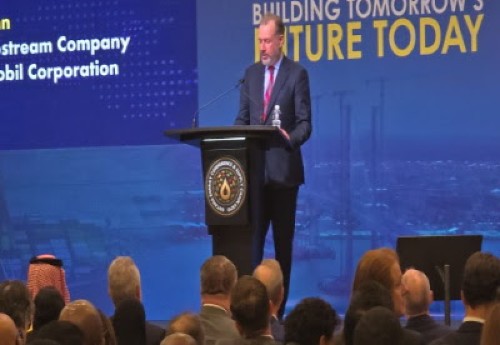 ExxonMobil’s Dan Ammann, addressing the fifth Guyana Energy Conference & Supply Chain Expo.“The same alignment that enabled Guyana’s oil success, clear roles, shared standards, transparency and disciplined execution will be even more important for natural gas,” Ammann, who is also the President of ExxonMobil Upstream Company, told the regional and international delegates attending the fifth Guyana Energy Conference & Supply Chain Expo.
The three day-event is being held under the theme “Building Tomorrow’s Future Today,” and is organised by the Guyana Energy Conference & Supply Chain Expo Secretariat t
Ammann said that with natural gas development being more complex than oil and requiring different infrastructure such as processing, compression pipelines and power systems, gas would succeed when the entire upstream, midstream and downstream value chain comes together in the right sequence.
Ammann said that ExxonMobil would match the pace of its partners in gas development which involves more players, utilities, industrial users, financiers and regulators, adding that ExxonMobil was committed to developing Guyana’s gas and maximising its value and impact for the country through rapid, safe and smart monetisation.
“When government advances, permitting approvals and market frameworks, we will advance engineering, execution and investment in lockstep. When government accelerates, we accelerate. Because the pace of gas development is not set by any one company.
“It is set by the readiness of the full system. That means regulatory approvals, environmental reviews, land and marine use decisions, downstream infrastructure and, critically, market demand. Our message is simple,” he said.
He told the conference that the development of the GUY$6.8 billion (One Guyana dollar=US$0.004 cents) Hammerhead project, which could produce up to 95 billion cubic feet of gas daily, would be the “first starboard project” that from the outset incorporates a plan to send gas to shore via pipeline.
He said a small portion of the gas would be used to run the floating production, storage and offloading vessel (FPSO) and the remainder to support the gas-to-energy project, future domestic industry or re-injection for optimised recovery.
“That flexibility matters because the smartest development plan is one that maximises value across oil and gas altogether,” he said, adding that Hammerhead could also serve as a practical bridge to phase two of the gas-to-energy project when Guyana chooses to advance it.
“More broadly, we see significant recoverable gas resources particularly in the southeast part of the Stabroek Block. We believe that opportunity is compelling,” he said.
Meanwhile, the Senior Minister in the Office of the President with responsibility for Finance, Ashni Singh, said Guyana’s economic transformation is the result of decades of policy reform, institutional strengthening and strategic investment.
He told the conference that Guyana has accumulated savings in its sovereign wealth fund sufficient to cover the country’s total external debt, while simultaneously expanding infrastructure and social services.
“We’ve been able to accumulate, in the sovereign wealth fund, enough savings now to pay off the total external debt of the country, all within the space of just about five years,” he said, highlighting the rapid growth of the oil and gas sector, pointing to the pace at which production has increased since first oil in 2019.
“We moved from one FPSO producing about 120,000 barrels of oil per day in December 2019 to four FPSOs producing about 900,000 barrels per day today.
“With the deployment of the next FPSO, we will exceed one million barrels of oil per day, and by the end of the decade, we expect production capacity of about 1.7 million barrels per day. By any standard, these are extraordinary numbers<’ he said, noting that the scale and speed of development are unlike anything previously seen globally.
Singh said Guyana’s ability to attract major investors such as ExxonMobil was not accidental but the result of long-term reforms following the restoration of democracy in 1992.
“At the turn of the 1990s, Guyana was essentially bankrupt. We were spending more than 100 per cent of government revenue on servicing debt, and the stock of debt was more than 600 per cent of GDP.
“It took decades of effort to rebuild institutions, liberalise the economy and establish Guyana as a credible destination for investment,” Singh said, adding that strong partnerships with private investors remain essential to financing development and sustaining growth.
Singh said the government’s approach to managing oil revenues seeks to balance saving for future generations with investing in infrastructure that drives long-term growth.
He said through the Natural Resource Fund, strict governance and transparency mechanisms ensure that revenues are managed responsibly while supporting national development priorities.
“Saving for future generations will manifest itself not only in monetary savings, but also in investment in public infrastructure that will generate returns over the long term,” he said, adding that a major priority is overcoming Guyana’s longstanding electricity constraints through the Gas-to-Energy project and related investments.
“For generations, Guyana has struggled to generate adequate electricity reliably and at a competitive price. That has limited our ability to process our resources and develop manufacturing.”
He told the conference that the Wales gas-to-energy project will double generating capacity and reduce electricity costs by about half, creating opportunities for manufacturing, agro-processing and other value-added industries.
“With cheaper and more reliable electricity, we anticipate the emergence of an industrial and manufacturing sector that has long been constrained by high energy costs,” Singh said, adding that the pace of change underway in Guyana is unprecedented, pointing to new highways, hospitals, schools, ports and airports being built across the country.
“We’re witnessing a transformation at a speed that we have never seen anywhere else. If anyone feels dizzy from the last five years, the next five years will be even more extraordinary,” he added.

