


KINGSTOWN, St. Vincent – Prime Minister Dr Godwin Friday says his government will use a rules-based strategy to tackle St. Vincent and the Grenadines mounting debt and fragile fiscal position.
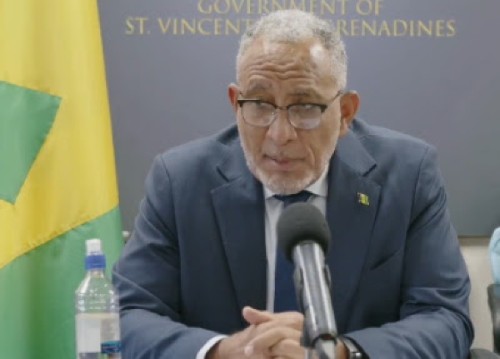 Prime Minister Dr. Godwin Friday speaking at news conference on Tuesday (CMC Photo)Prime Minister Friday, who is also the Minister of Finance, said the country “cannot continue on the course that we have been going for the past several years” and still hope that “somehow the challenges will resolve themselves”.
He, however, said that while international institutions are providing technical support, the recovery programme will be homegrown and rooted in national ownership.
“We will implement, we will develop, devise, of course, with your technical assistance, as we have said, you have offered, our homegrown economic stabilisation programme that will ensure that we have national ownership of the recovery journey on which we are embarking, Dr. Friday said, flanked by Sergei Antoshin, who headed an International Monetary Fund (IMF) mission to Kingstown.
“We are on that journey,” Prime Minister Friday said, referring to the Washington-based financial institution and welcoming what he described as a balanced approach from international partners.
“I welcome, quite frankly, the tone and the approach that you have demonstrated in your presentation here today, but also in our conversations, to understand that it is not just a balance sheet matter… it involves people’s lives,” Friday said.
He said that any adjustment programme must be socially fair, particularly in the face of high oil prices and inflation.
“We have to have a social consensus to be able to say, ‘OK, together, we will meet these challenges,” he said.
“The costs of these higher oil prices and higher costs of inflation and so forth… will not be borne disproportionately by those persons who are most vulnerable, because they’re the ones who feel it first.”
Prime Minister Friday said the protection of the most vulnerable are central to any reform efforts.
“We have to ensure that whatever we do with respect to adjusting to these developments, that those persons, the most vulnerable, are given the greatest level of protection,” Friday said as he spoke about the seriousness of the country’s situation while insisting that his government is committed to a homegrown, socially just path to recovery.
“We are aware of the challenges in the current situation,” he said, pointing to high oil prices, persistent fallout from recent natural disasters, and a debt-to-GDP ratio of 113 per cent in 2025, which projections suggest could rise to 145 per cent by 2031 if current policies are unchanged.
“The present course has gotten us to where we are, which is, as you have identified, a very difficult fiscal situation,” Friday said five months to the day that he became the country’s fifth prime minister.
He underscored the need for change, noting that Antoshin, had emphasised this in his comments to the media.
“You’ve said that very clearly in your remarks, that if we continue on the course that we are now, that it is not a sustainable approach to development,” Friday said, referring to the IMF delegation.
He pointed out that St. Vincent and the Grenadines has been rated at a high risk of debt distress since 2016, and that external shocks — especially oil prices — have aggravated an already precarious position.
“We are still recovering from the natural disasters that struck our country in the last few years. However, all of those things still do not obviate or relieve us of the responsibility of dealing with the problems as they arise.”
Prime Minister Friday said his administration is determined to break with past fiscal behaviour, a reference to the policies of the now opposition Unity Labour Party (ULP), which had been in office from March 2001 to last November.
“We understand that we cannot continue on the course that we have been going for the past several years, and expect that somehow the challenges will resolve themselves,” Friday said, adding that the government will establish a rules-based fiscal framework with legal backing and clear, measurable targets that is transparent and accountable.
The prime minister stressed the importance of signalling seriousness to both citizens and international partners.
The framework includes a primary surplus target of three per cent of GDP by 2029.
“… you have noted it’s challenging because you need to have a turnaround 11 percentage points in a short space of time, but we understand that we have to set ambitious targets,” the prime minister told the IMF delegation.
“It has been done elsewhere. It’s not been our record, but it has a matter to do with how we have governed, rather than what is possible.”
He said that his government intends to realign with Eastern Caribbean Currency Union (ECCU) prudential guidelines “of 60 per cent debt to GDP benchmark”, adding that fiscal responsibility must go hand in hand with growth.
“We’re prepared to do what is necessary here in a way that is going to set our country on a path towards fiscal responsibility, but also one that generates growth… and that we do so in a way that is both responsible and sustainable,” Prime Minister Friday told reporters.

