


BRADES, Montserrat - The ongoing war between the United States and Iran in particular the control of the Strait of Hormuz is forcing Caribbean governments into some form of a dilemma as they seek to provide subsidies to their citizens in order to deal with the impact of the high cost of energy.
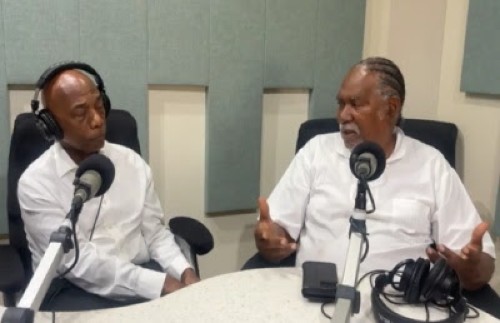 Premier Reuben Meade (Right) and dr. Hyginus ‘Gene’ Leon, the Executive Director of the Development Bank for Resilient Prosperity (DBRP), during the radio programme on Tuesday (CMC Photo)Montserrat Premier Reuben Meade, appearing on a radio programme here Tuesday with Dr. Hyginus ‘Gene’ Leon, the Executive Director of the Development Bank for Resilient Prosperity (DBRP), a global multilateral institution created to serve Small Island Developing States (SIDS), told listeners that one has to prioritise how you spend the limited resources that are available to governments.
“Sometimes we provide subsidies as a tremendous cost to the government and that cost has to be recouped in some way and it is recouped from the taxpayers. So you believe you’re getting something on one side but the government is getting it back from you one way or the other on the other side,” Meade, an economist said.
“So we have to be very prudent in terms of how we introduce subsidies,” he said, noting that in the case of Montserrat, “one way of subsidising public transport, we have reduced the freight element for the calculation of import duties by 50 per cent and that too is a subsidy because we know what is happening with freight charges.
“So that’s the Montserrat position. The other Caribbean territories will do what they can because most of them are in a position so to do based on their own fiscal position. But the fiscal position as it remains in Montserrat means that with 67 cents on the dollar funded by HMG (His Majesty Government), we do not have the fiscal space to provide general subsidies,” he added.
Leon, a former president of the Barbados-based Caribbean Development Bank (CDB), said that citizens throughout the Caribbean need to keep in mind that it doesn’t matter whether it’s Montserrat or anywhere else for that matter in the world ”there is no free lunch.
“There is no free lunch and subsidies will always be a need,…at any one point in time in the future. The issue at hand is living today versus living or being able to live tomorrow. And the choice that I think is always before any government is how do you spend the monies that you have access to, the monies that you will be able to have on activities today that does not prevent you from being able to live tomorrow.”
The St. Lucian-born economist told radio listeners here that so when Premier Meade talks about subsidies in Montserrat “the alternative of which segments get that subsidy, for how long, and what do you put in place for tomorrow to reduce the risk of needing to continue to provide subsidies, this is the essence of the policy, the trade-off that needs to always occur.
“Now at some point one person or one group may always feel enough attention is being provided to them, but if you have to make a choice between being able to fund a hospital or being able to fund education or being able to fund transport logistics versus which is about tomorrow and viability tomorrow versus being able to live a little better today, that is a trade-off that I think depends on where you are and how you see it.”
Leon said that this is why he made the point that there has to be joint responsibility “because part of it is an acceptance by people that they can also contribute by reducing their need while the government can help support particular segments such that you minimise the overall impact on society while you secure a better future for people tomorrow.
“So the subsidy issue is not about am I denying you of today’s benefit, it is more about how am I balancing or minimising your discomfort today while promoting a better living space for you tomorrow,” Leon told radio listeners.
Oil prices have surged to their highest level in a month as renewed hostilities between the United States and Iran continued for a third consecutive day, dampening hopes for a return to normality in the Strait of Hormuz.
Brent crude, the primary international benchmark, rose as much as 3.8 per cent on Tuesday, extending a 9.6 per cent gain from the previous day.
After easing to pre-conflict levels following Washington and Tehran’s signing of a memorandum of understanding (MoU) for peace last month, Brent has risen 19 percent from its price before the start of the US-Israel war on Iran in late February.
Premier Meade said what has been done in terms of fuel subsidy is that “we have focused on providing subsidies to the bus drivers, because the people who use public transport are the lowest earning persons in the island.
“ And it is tied to the price of fuel. So if the price of fuel falls back to normal levels, then the subsidy goes. But up until a week ago, the entire world felt that the oil prices were falling, and now we are hearing that the United States has now closed the Strait of Hormuz.
“Now I don’t understand how they have closed it when Iran had closed it before, but they are blockading the closed Strait. So you are double-locking the Strait of Hormuz. And secondly, coming out of the United States, they want to implement a toll for the use of the Strait of Hormuz when in fact the Iranians are saying, we will impose a toll.”
Meade said that the positions of the two countries will result in fuel prices are rising again “which means that you are doubling up on your subsidies and so you are deflecting resources from much-needed other investments into a very short-term benefit.
“And we have to stop looking at short-term benefits and look at the longer-term goals,” Meade said, adding “for example, we are now getting ready to prepare tender for the development of geothermal, so that we can now have our grid being fully sustained by both geothermal and solar.
“Now, those are investments, which, had we been using those funds for subsidies, we would not have been able to make. And if we provided the subsidies, that shortfall will have to take up as borrowing to deal with that fiscal deficit, which means that the people have to pay the interest and pay the returns on that,” he told radio listeners.

