


Caribbean Solar Is Growing Faster Than Official Figures Show
SANTO DOMINIGO, Dominican Republic – The Caribbean has installed almost twice as many solar panels as officially recorded between 2021 and 2024, according to a new report by global energy think tank, Ember.
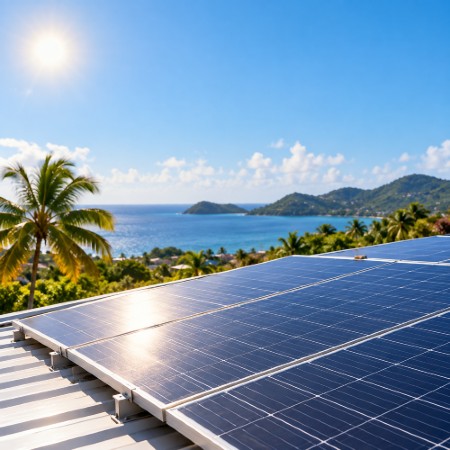 But despite renewables being cheaper than fossil power, policy barriers are holding back faster deployment, leaving the region dependent on imported fuels, with high electricity prices and exposure to global price shocks.
“Policies, not costs, are the main barrier to renewable deployment in the Caribbean,” said Ember’s Latin America analyst, Wilmar Suárez.
“The Caribbean remains highly exposed to fossil fuel imports, and every price rise feeds through to the cost of living for households or to the public accounts.
“The Caribbean now has a real opportunity to reimagine its energy system: one that is not exposed to the volatility of fossil fuel markets and is more resilient to hurricanes and storms. Leaders who act decisively will position their countries at the forefront of this historic opportunity,” he added.
The report circulated at the ongoing Latin American and Caribbean Energy Organization (OLACDE) Energy Week here, analyses power sector data across 13 countries in the Caribbean namely Antigua and Barbuda, the Bahamas, Barbados, Cuba, Dominica, the Dominican Republic, Grenada, Haiti, Jamaica, St. Kitts and Nevis, St. Lucia, St. Vincent and the Grenadines, and Trinidad and Tobago.
The report notes how the Caribbean is highly dependent on fossil imports. In 11 of the countries analysed, all of the fuel used for electricity generation was imported. Across the countries analysed, more than 90 per cent of electricity was generated with fossil fuels – predominantly gas and oil products.
The economic impact of the Caribbean’s fossil dependence is clear. Every Caribbean country where data was available spends more of its gross domestic product (GDP) on fossil imports than the global average of 3.2 per cent.
In Jamaica (9.5 per cent) and Barbados (7.3 per cent), it is more than double. This exposure is visible in increases in inflation following oil shocks in 2008 and 2022, with further impacts expected following this year’s crisis in the Strait of Hormuz.
Electricity in much of the Caribbean is among the most expensive in the world, with a regional average of around US$0.25 cents per kilowatt-hour, more than double the median price in emerging economies (10 c/kWh).
The report notes that the region’s fossil dependence persists even though renewables are already contracted at lower prices than fossil power.
In the Bahamas, the state utility contracted solar at less than half the price of gas-fired generation in the same contracting round. In June 2026, the Dominican Republic awarded renewables with batteries at a lower price than its distribution companies were paying generators on average the year before.
Globally, more than 90 per cent of utility-scale renewable projects commissioned in 2025 produce cheaper electricity than the cheapest new fossil plant available in their market.
These low costs have led to faster renewable deployment than official statistics suggest, but still not fast enough to meet national targets and bring down energy costs.
The report estimates that the Caribbean has installed 2,280 MW of solar panels between 2021 and 2024, based on analysis of imports from China, which is almost twice as many as officially recorded (1,269 MW). Eleven of the countries analysed have renewables targets, but only six are verifiable, and none of those six is on track.
As a result, renewables accounted for less than a tenth of electricity in 2024 in the thirteen countries analysed (nine per cent), compared to 32 per cent worldwide. The report shows that this renewable share could reach 23% by 2030 if the six countries with verifiable targets achieved these, resulting in a 9% reduction in fossil generation.
The report recommends three policy changes to reduce barriers to renewables deployment: targets that are independently checked; licensing and grid connection decided independently of the utility; and tenders designed around what the system needs, with the result published.

