

In the history of Haiti's political leadership, Michèle Duvivier Pierre-Louis holds a distinction that deserves greater recognition. In September 2008, she became the second woman to serve as the country's prime minister, following Claudette Werleigh, who held the position between 1995 and 1996.
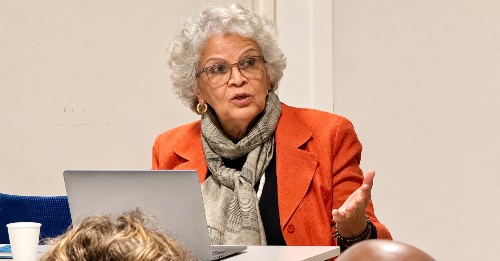 Her appointment came at a difficult moment for Haiti. The country was grappling with political and economic instability when four hurricanes struck in rapid succession, causing widespread damage and deepening the country's humanitarian and economic challenges. Pierre-Louis, who had previously served as minister of justice and public security, assumed leadership of the government during this period, remaining in office until November 2009.
For a woman to occupy one of the highest positions of political authority in Haiti was a significant moment. But Pierre-Louis's professional journey had never been limited to politics. Her background in education and civil society had prepared her for a broader form of public service, one that would continue long after her departure from government.
Nearly two decades after making history, she remains engaged in the work of strengthening Haiti's institutions and expanding opportunities for its people. Her focus is on a question that has become central to her career: what must a society put in place to ensure that its citizens can meaningfully participate in determining their future?
Investing in people and institutions
In 1995, thirteen years before becoming prime minister, Pierre-Louis established Fondation Connaissance et Liberté, better known as FOKAL. The foundation was created to support education, knowledge, cultural development and civil society in Haiti.
As its president, she has overseen work spanning literacy, higher education, sustainable development, human rights, gender justice and the preservation of national heritage.
Her involvement in education predates the foundation. She participated in Haiti's Mission Alpha literacy campaign and has long maintained that access to knowledge is fundamental to building an informed and engaged citizenry.
That belief also informs her understanding of democracy. For Pierre-Louis, democratic governance cannot be sustained through elections alone. Citizens must have the information, education and freedom to engage with public institutions and hold those in positions of authority accountable.
“Democracy requires enlightened leaders and educated informed people,” she says.
She often invokes the words of French philosopher Jacques Rancière: “Democracy is not a destination, it is a way to travel!”
The statement reflects her belief that democracy is an ongoing process, requiring continuous investment in public institutions, education and civic participation.
It is a perspective shaped by her experience in government as well as her subsequent work outside it. Political leadership may establish policy priorities, but the institutions and civic structures that sustain a democracy require consistent attention beyond individual administrations.
Why Haitians must lead Haiti's development
Pierre-Louis is equally concerned with the way Haiti's development is approached by international organizations and external partners.
She acknowledges the importance of international cooperation, but believes that meaningful progress requires a stronger recognition of Haitian knowledge, expertise and institutional capacity.
Her message to international partners is simple: “Listen to us. Trust those that can be accountable.”
She argues that development initiatives must take into account Haiti's particular history, social structures and national circumstances. Solutions designed elsewhere cannot automatically be expected to work in Haiti without the involvement of local organizations and the communities they serve.
Through FOKAL, she has worked to support Haitian institutions and community-based organizations, emphasizing the importance of strengthening local capacity.
Her position speaks to a larger issue affecting development across the Caribbean: the relationship between international funding and local decision-making. Resources are important, but so is ensuring that the people and institutions closest to the challenges have a meaningful role in determining how those resources are used.
For Pierre-Louis, Haiti's future cannot be built through external intervention alone. It requires capable institutions, informed citizens and a development process in which Haitians are active participants rather than passive beneficiaries.
Culture as an essential part of progress
Another dimension of Pierre-Louis's work is her commitment to the arts and cultural sector.
She currently serves as chair of Le Centre d’art, an institution connected to Haiti's artistic heritage, and chair of the Caribbean Culture Fund. Through these roles, she has continued to advocate for greater recognition of the relationship between culture and development.
Pierre-Louis sees artists as important contributors to society. Their work preserves collective memory, explores national identity and provides ways to examine the social and environmental issues affecting communities.
Her philosophy is reflected in her approach to cultural philanthropy. She has argued that investment in the arts should not be separated from other development priorities, particularly as artists increasingly engage with issues such as climate change, community development and social cohesion.
“Philanthropy is power,” she has said, calling for art to exist “at the intersection of every other sector.”
The idea reinforces her broader belief that development must recognize the many different contributions that make a society stronger. Education, culture, civic participation and institutional accountability are interconnected rather than competing priorities.
Beyond her work in Haiti, Pierre-Louis has also served on international commissions and United Nations advisory bodies addressing issues including the death penalty, development and mediation. She is also a professor at Université Quisqueya, maintaining her connection to higher education and the development of future generations.
A different way to think about Haiti's future
Pierre-Louis's place in Haitian history is established through her appointment as the country's second woman prime minister. But her continuing contribution is found in the work she has pursued across education, civil society, culture and international development.
For Caribbean communities, her story is a reminder that women's political leadership has already been part of Haiti's history, even if that achievement is not widely recognized. It also provides an opportunity to consider the many forms leadership can take beyond holding public office.
Her perspective challenges the tendency to define Haiti exclusively through its political and economic difficulties. While the challenges are considerable, she draws attention to the people, organizations and institutions working to strengthen the country's foundations.
Ultimately, her message is that Haiti's future must be shaped by Haitians themselves. That requires investing in education, building accountable institutions, supporting local organizations and recognizing the importance of culture in national development.
It is a vision grounded not in a single political appointment, but in decades of work and a belief that lasting progress begins with people having the knowledge, resources and opportunity to shape the society in which they live.

