


GEORGETOWN, Guyana – The Ministry of Health on Thursday announced that all citizens will be able to benefit from eye care support through an expanded healthcare voucher programme.
 This follows the signing of a Memorandum of Understanding (MOU) with 67 private healthcare providers .
The major expansion removes previous age restrictions that limited the service to persons 18 years and younger and those 50 years and older.
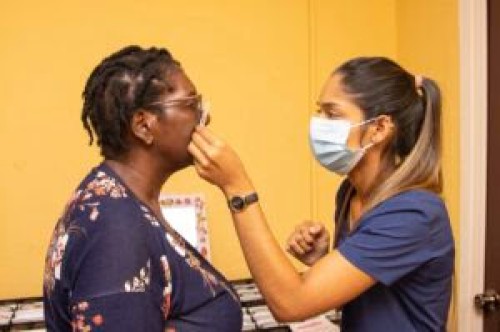
Minister of Health, Dr Frank Anthony, announced that anyone requiring an eye test can now receive one under the programme and, if necessary, access spectacles.
Available eye care vouchers include the eye testing voucher valued at GUY$2,000 and spectacles voucher valued at $15,000.
Beyond eye tests, the Universal Health and Cervical Cancer screening vouchers are also available.
Each voucher must be used to its full value, with any additional costs to be covered by the beneficiary.
The signing of the MOU marks the restart of the voucher initiative for its third consecutive year.
Ib 2025 alone, 326,868 vouchers were utilised, a figure the Minister said demonstrates strong public interest in accessible healthcare.
“This has been a very successful programme for us,” Dr Anthony said.
Through the eye care programme, approximately 1,200 persons were identified with cataracts and were able to access treatment.
The cervical cancer screening voucher, valued at $8,000, has also played a critical role in early detection. Over the past two years, 20,000 women accessed HPV testing through the programme, with a 19 per cent positivity rate.
“If they test positive, we are able to bring them into care,” the Minister revealed.
He, however, stressed the need to double participation to 40,000 women by the end of this year.
Universal health vouchers, valued at $10,000, are available for both children and adults and can be uplifted from health centres nationwide. Some 13,000 children and 91,000 adults benefited from the programme, with women accounting for 64 per cent of adult users. As a result, the Health Minister is encouraging more men to take advantage of the service.
“We want more men to get these vouchers and also to get themselves tested,” he said.
The programme has also supported chronic disease monitoring. About 37,000 persons accessed HbA1c testing, with nearly 8,000 showing very elevated levels.
Anthony noted that the data collected allows the ministry to analyse trends by region, locality, and gender, strengthening preventative healthcare efforts.
While the programme continues to grow, challenges remain in some regions, particularly in hinterland communities. The minister urged providers to conduct outreach activities to ensure equitable access.
“We don’t want people to just be on the coast. We want people to go into the regions where they don’t have access to these tests,” he said.
He emphasised that the partnership with private providers goes beyond administrative arrangements and is key to improving national health outcomes.
The ministry is also considering adding abdominal ultrasound services to the voucher programme in the future.

