


KINGSTON, Jamaica - The leader of the main opposition People’s National Party (PNP), Mark Golding says he is not convinced over the reasons offered by the Jamaica government for ending the decades old Cuban health brigade programme here.
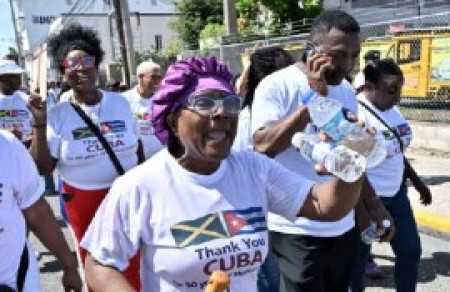 Jamaicans protesting the end of the Cuban health programme“For the record, we thank the government and people of Cuba for their 50 years of valuable and selfless service to the Jamaican people, and we join with other Jamaicans who regard this so-called ‘principled realism’ an act of spineless capitulation to external pressure, at the expense of the Jamaican people,” said Golding told Parliament on Tuesday.
In his contribution to the 2026/27 budget debate, Golding said he had taken notice of Prime Minister Andrew Holness’ recent statement to his fellow Caribbean Community (CARICOM) colleagues about adopting a foreign policy of “principled realism”.
“I wondered uneasily to myself what that potentially self-contradictory concept meant to him, but it wasn’t long before its first manifestation emerged when the Jamaican government unilaterally terminated the 50-year Cuban Medical Assistance Programme,” Golding said.
The Jamaica government said it had always valued the contributions made by the Cuban health brigade to the island even as it acknowledged that the United States “has publicly raised concerns about the operation of the medical programme globally”.
The Ministry of Foreign Affairs and Foreign Trade was responding to a statement from Cuba that it was withdrawing all its medical professionals from Jamaica less than 48 hours after Kingston said it was discontinuing the current arrangement with Havana.
“Cuba regrets the decision of the government of Jamaica to cease medical cooperation, yielding to pressure from the U.S,” according to a statement issued by the country’s Ministry of Foreign Affairs.
It said that on March 4, the Foreign Ministry of Jamaica communicated to its embassy in Kingston “the unilateral decision of its government to terminate the health cooperation agreement that has linked both nations for decades.
Golding told legislators that Foreign Affairs Minister, Kamina Johnson Smith, having told Parliament that the decision had “nothing to do” with pressure from the United States, “a few days later had her ministry subsequently issue a statement affirming that it is ‘widely known’ that the US has publicly raised concerns with the programme”.
The Opposition Leader said that Johnson Smith then articulated “unconvincing reasons” for her government’s justification in terminating a programme “which has done so much to help Jamaicans to have access to quality health services and the termination of which has left a massive, unfilled gap in health care delivery, especially in under-served areas”.
Golding’s statement came as several Jamaicans took to the streets on Tesday to protest the end of the Cuban health programme.
“My husband is one of the beneficiaries of the Cuban medical professionals. He had one of his eyes done at St Joseph’s Hospital and was supposed to get the other one done, but when he went back, they sent him to KPH (Kingston Public Hospital) because the Cubans have gone home,” said the 61-year-old wife of the man.
The protest march was organised by Michael Ennis, a retired information technology professional, who insisted that the action “is a gratitude walk” indicating that people had travelled from across Jamaica and the diaspora to take part.
“The aim is to send a message to the Cuban people that Jamaicans appreciate what they have done for us,” he added.
As they walked around National Heroes Circle in Kingston, the protestors shouted “We need nurses, we need Cuba!,” “We love Cuba”, “Bring back the nurses”.
In recent times, several Caribbean countries have announced their intention to restructure the decades old programme with Cuba under its Cuban health brigade project in light of efforts to by the United States to get regional countries to end the programme.
Washington has said the Cuban regime’s “medical missions” programme, which has benefitted several Caribbean countries “relies on coercion and abuse.
“Cuban medical workers face withheld wages, confiscated passports, forced family separation and exile, restriction of movement through curfews and surveillance, intimidation and threats, and even pressure to falsify medical records and fabricate procedures. Many also endure excessive work hours and unsafe conditions,” the US said.

