


Guyana's President Urges Caribbean Broadcasters to Embrace AI and Become More Innovative
GEORGETOWN, Guyana – President Irfaan Ali has urged Caribbean broadcasters to use artificial intelligence as a tool to strengthen journalism rather than let it erode the region’s identify.
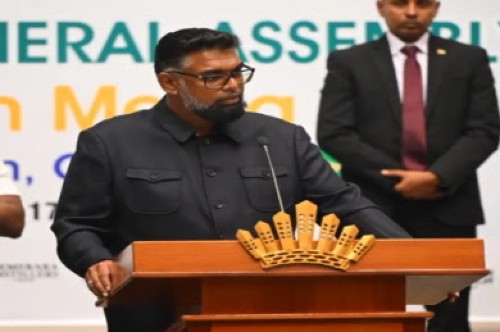 President Irfaan Ali addressing the annual general assembly of the Caribbean Broadcasting Union on Tuesday night (CMC Photo)Ali addressing the 57th annual general assembly of the Caribbean Broadcasting Union (CBU) on Tuesday night, also called for media organisations to become more creative about revenue in a changing regional and global landscape.
“But, and this is important, we should not simply imitate the global platforms. We must use their technology to distribute our content. The answer to globalisation is not cultural isolation. It is cultural confidence. Let us have more West Indian content on global platforms.”
Media and AI” that a reporter standing in a community after a hurricane is not simply collecting data about wind and rainfall and wind speed and rainfall.
“The reporter is seeing the old woman sitting outside a damaged house. This child searching through the remains of a school bag. The fisherman looking at a destroyed boat. The family wondering where they will sleep tonight. And just like that a journalist…should notice those things.
“Those are not data points. They’re human experiences, and that is why I believe the future of media must remain human-centred. Use AI, certainly use it to transcribe interviews, use it to search enormous databases, use it to analyse data, use it to translate, use it to identify patterns, use it to help newsrooms that are under-resourced, but never allow the technology to become the journalist.”
Ali warned that “the moment we surrender editorial judgement to the machine, we risk surrendering something more important than efficiency. We risk surrendering responsibility, and responsibility is at the heart of broadcasting.
“So what then are the major challenges confronting Caribbean media? I would humbly like to suggest four such challenges. Of course, the challenge of economic sustainability. Broadcasting costs money. Television production costs money. Newsroom costs money. Cameras cost money. Transmission costs money. Training costs money. Investigative journalism costs money and yet, the traditional advertising model is under extraordinary pressure.”
Ali said that the Media Institute of the Caribbean has estimated that between 15 and 25 per cent of advertising revenue in some Caribbean markets are now being diverted to global platforms, such as Google.
“Think about what that means. At the upper end, one dollar in every four of advertising expenditure can be moving away from Caribbean media and towards global technology companies.
“How can a small Caribbean television station compete with a global company whose market is the entire planet? This requires a new economic model. Caribbean media organisations must become more creative about revenue,” Ali said, adding that he hopes the CBU can come up with some ideas on this issue.
He said the second challenge is the fragmentation and migration of audiences.
“The television audience is no longer what it once was. S&P Global reports that pay TV presentation across Latin America and the Caribbean fell from 42 per cent of TV-owning households in 2016, from 42 per cent to 31 per cent in 2024, as streaming services gained popularity.
“That is an 11 percent decline. It represents a profound transformation in the way people consume video. The viewer is moving and if the viewer is moving, the broadcaster must move too,” he said, noting as an example, the manner in which sporting events are now packaged to a changing audience.
“… look at the pre-show and the post-show, and look at the way the game is packaged to create revenue opportunity. To create audience, to create connection, to create rivalry. That’s a good example as to some of the things that need to be readjusted.
“When you look at our population, the largest segment of the population are young people and we have to be able to communicate to that segment. Now, it represents a profound transformation in the way people consume video. The viewer is moving and if the viewer is moving, the broadcaster must move too.
“We cannot complain that young people are not watching television and then continue producing television as though it was 1995. We must see audiences where they are. We must build new partnerships. We must build new partnerships with the mobile companies that seek to have an integration of technology that supports broadcasting.
Meanwhile, CBU president, Anthony Greene, said that regional media professionals must embrace artificial intelligence as a tool to strengthen journalism, while maintaining the core principles of accuracy, verification and public trust.
The CBU president said that despite the rapid evolution of technology, the fundamental responsibility of the media remains unchanged.
“Technologies, platforms and audience habits will change, but the core obligations of journalism remain: to verify, to require context, to protect the vulnerable, to challenge power and to serve the public,” he said.
But he warned of the dangers posed by AI-generated misinformation, particularly during emergencies, where false information presented as coming from an official source could endanger lives.
Greene also noted that access to trusted information remains critical, regardless of whether citizens receive it through radio, television, mobile platforms or other digital channels.
“Let us use AI to strengthen journalism, rather than allowing AI to weaken journalism,” he said, highlighting the need to protect media archives and intellectual property, improve the representation of Caribbean and indigenous languages in AI tools and ensure young content creators uphold professional standards.
Tuesday night’s opening ceremony also featured the induction of the late Jamaican academic Professor Aggrey Brown and the late Guyanese journalist, Ricky Singh into the CBU Media Hall of Fame.
Belizean journalist Jules Vasquez was presented with the inaugural Caribbean Defender of Media Freedom Award.

