


GEORGETOWN, Guyana – Stabroek News Friday said that its last edition will be printed on March 15 this year and that the publishing company, Guyana Publications Inc (GPI), has already begun the process to go into voluntary liquidation.
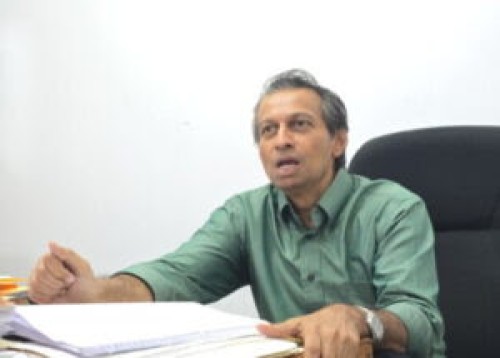 Stabroek News Editor in Chief, Anand Persaud, speaking to reporters on Friday.The newspaper Friday announced its closure after nearly four decades and the Editor-in-Chief Anand Persaud, said that the impact of digitalised social media delivery of news, a shift of advertising to Online platforms as well as the political environment had all conspired to force the privately-owned to close down operations after 39 years.
Persaud said circulation had dropped from a peak of 40,000 copies on Sundays and 18,000 daily to about 4,000 to 5,000 copies
“Everybody in the newspaper world has fallen. They’re all grappling with that, too so it is a fact of life,” he said, adding that GPI is solvent and would be in a position to pay severance and funds from a contributory pension scheme to its 60 staff members.
“The newspaper is solvent, is in a position to meet all of its obligations to staff in terms of severance and in terms of unpaid leave and in terms of other things,” he told reporters.
But he acknowledged that the “collapse of the advertising market has been a serious issue. You know, there may be some advertisers who did not advertise because they didn’t want to be seen to be affiliated with Stabroek News because that might put them out of favour with the government
“But generally, what happened here was that over time, both the advertising and subscription market fell away because people were so engrossed on their phones and what they can see in live real time, newspapers can only provide the next day, 24 hours after and that became obsolete,” he said.
Persaud said the large companies like Digicel, One Communications, Banks DIH, Demerara Distillers Limited and Courts have over the years shifted their advertising to Online platforms, leaving the newspaper with statutory State advertising, occasional financial statements from the banks, which have to go into a newspaper, and legal notices. “So the collapse of the advertising market has been a serious issue.”
In the statement announcing the closure, two of the main shareholders noted that in the past year, the state-run Department of Public Information (DPI) had accrued a debt in excess of GUY$80,000,000 in unpaid advertisements.
“ The debt persists despite repeated private and public entreaties to clear it. “This tactic could equally be construed as an attempt to starve this company of its operating funds,” they said, adding that publishing has always been a precarious undertaking in Guyana and the Caribbean due to the modest size of the potential readership, and to other market constraints.
“No-one becomes a publisher in Guyana to grow rich. While the company has never been driven by a concern about profit, it must function as a business. It is a given that any business needs to continually diversify and adapt and to seek alternative sources of income.”
Last month, the Trinidad-based daily newspaper, Newsday closed down its operations after 32 years.
Asked by reporters whether he believed that changing geopolitics had contributed to Stabroek News’ closure, Persaud said it was more about market forces here and even in the US where newspapers have been “decimated”.
“it has very little to do with how geopolitics might have affected that market. It’s just simply people do not go to buy a newspaper in the morning anymore. Very few people do that,” he said, noting that the subscriber base for most newspapers these days are the oldest customers who are dying or migrating.
“Younger readers are just not buying newspapers because they’re not accustomed to that. What they’re accustomed to do is picking up their phone or their tablet in the morning and scrolling, and that is really the thing so I think that’s really the major factor. I don’t think geopolitics go that far in terms of isolating us,” he said.
Persaud said Stabroek News and over the past five years examined a number of options such as going partly digital and maintaining part of the print run but nothing stood out as providing long-term security and a lot of the digital revenues were “ephemeral” and could not be relied upon.
He said GPI preferred to make the tough decision to close operations rather than rely on anyone for financial support.
“In the light and in the mode of our being an independent newspaper, what you want to do is to leave with dignity. We want to leave on our feet rather than live on our knees, beholden to anybody and to have to sort of like to be in that position.
“So, unfortunately, our stint as an independent newspaper has come to an end, but it is very important that this job be continued by others who are in the media. It’s clear that it’s all going to be social media driven these days, but the role that Stabroek News played between 1986 and now needs to be played by others,” he added.

