


Barbados Wants a Reform of UN Security Council and Throws Support Behind Caribbean Candidate
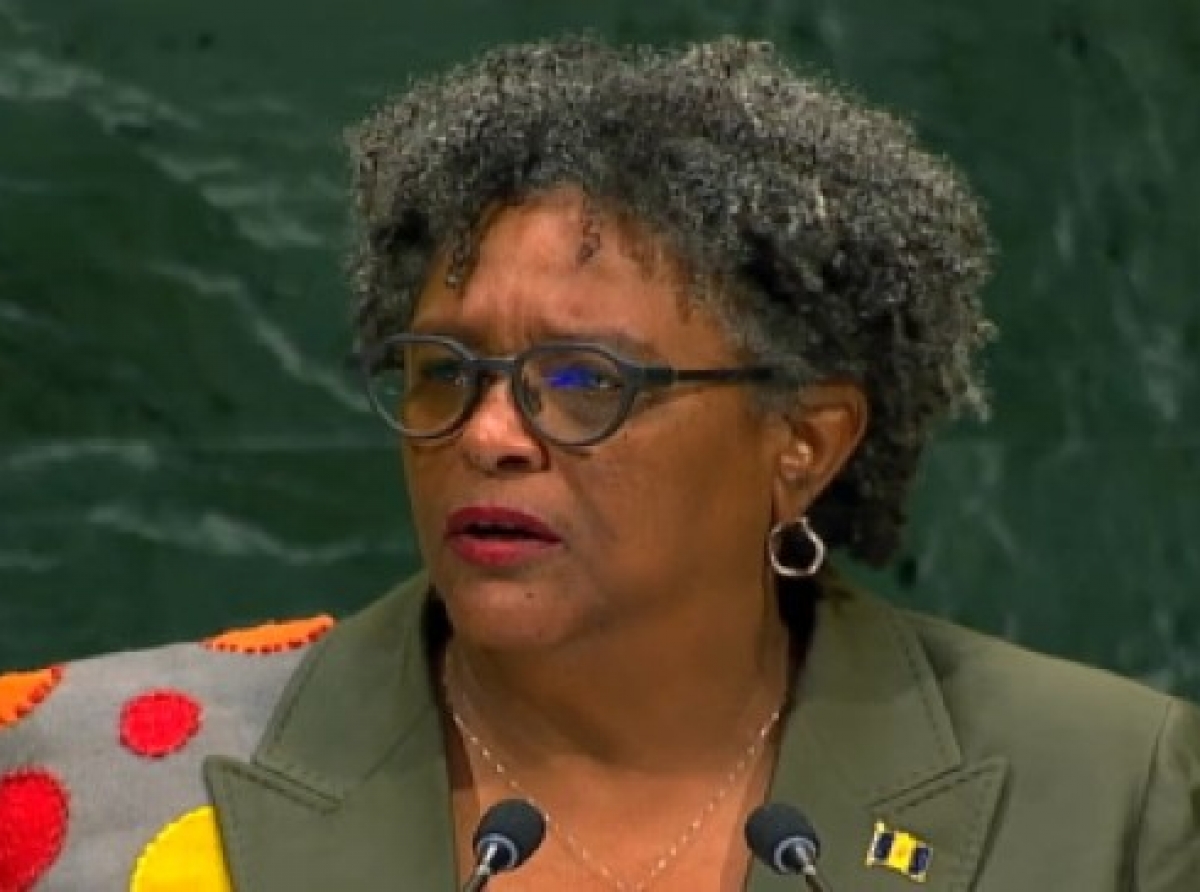
UNITED NATIONS – Sixty years after it became a member of the United Nations, Barbados on Thursday called for a reform of the UN Security Council with particular emphasis on the use of the veto power and its overall membership.
Prime Minister Mia Mottley told the 81st session of the United Nations General Assembly (UNGA) that since its formation, the Security Council has had 15 members with five of them being permanent members “armed with the veto”.
She said Africa, with 54 states, has no permanent seat and that this must change.
”Small island developing states confront threats that now reach squarely into the Council’s mandate—from climate insecurity and illicit arms flows to organized crime and displacement—yet in spite of constituting almost one quarter of the world’s sovereign states, we have no assured representation within it,” she said, adding “this too must change”.
Mottley told the Assembly that while the world has changed, the UN Security Council has not and that “it must do so now.
“But reform is not only about who sits at the table. It is also about how power is exercised. Barbados is therefore joining 123 other states in supporting the Franco-Mexican initiative on the use of the veto in cases of mass atrocities.”
The Franco-Mexican initiative is a political declaration that calls on the permanent members of the United Nations Security Council to voluntarily and collectively refrain from using their veto power in situations involving mass atrocities, such as genocide, crimes against humanity, and large-scale war crimes.
Mottley said its principle is fundamental, adding “where populations face genocide, crimes against humanity or large-scale war crimes, the veto should not be allowed to paralyze the Security Council when action is most urgently needed.
“This is why people are losing trust in the UN and in the Council,” she argued, saying that even “as we call for greater equity with the reform of the Security Council, we must reform the Secretariat to better support peace keeping and the resolution of conflicts.
“We have been told that there are more conflicts today than at any time since the United Nations was established. Regrettably, these conflicts are in almost every corner of the planet.” Mottley said the Oslo Peace Institute reported that 2025 was responsible for the battle-related deaths of approximately 245 000 individuals, making it the third most violent year in the post-Cold War era.
She said that the scale of human tragedy is mounting, whether in Gaza and the West Bank, Lebanon, Yemen, Sudan, Ukraine and elsewhere.
“Last year we feared that there was a risk of conflicts in the Middle East widening ever further. These fears have come to pass. And with a global impact. Increases in energy and transport costs and in interest rates have spurred inflation. It means that no one, even on the other side of the world can escape the hardships in meeting daily needs.
“The truth is, until there is a two-state solution that respects the rights and territories of both Israelis and Palestinians, we will continue to live on the edge.”
The Barbados Prime Minister said that there was need to address “with laser like focus each and every one of these conflicts” adding that the UN should “deliberately and systematically” deploy nimble mediation teams, led by political leaders, current and retired, on behalf of the Secretary-General and enjoying the SG’s confidence and authority and the respect of member states.
“They will help lift the heavy weight necessary to end these conflicts and bring peace and dignity to those affected populations. We know many hands make light work. They need to be supported by a quicker and technology-enhanced observer force, capable of rapid deployment to monitor and support cease-fires and peace agreements.
“Let us work together with the parties to these conflicts to build dialogue and bring opportunities for investment and jobs to the affected populations. And as for the wider international legal order, we know that countries of every size and capacity depend on a system in which rules are made collectively and applied consistently and fairly. “
Mottley warned that without an equitable rules-based order, smaller states, like Barbados, will simply cease to exist, adding that this is why her country is a cosponsor of the P4M, a grouping focused on strengthening multilateralism and to beat back the undertakers of multilateralism.
Mottley said that Barbados was joining the Caribbean Community (CARICOM) countries in supporting the Guyanese diplomat, Carolyn Rodrigues-Birkett, to be the next UN Secretary General, as the incumbent, Antonio Gutteres second five-year term ends in December.
“At a moment when the international community is being called upon to renew its faith in multilateralism, we believe that Ambassador Rodrigues-Birkett brings to this task the experience, skills and understanding required to serve the entire membership of this organization,” Mottley said.
Regarding the issue of Artificial Intelligence (AI) which Mottley described as “one of our new challenges,” she said it is clear that its potential is extraordinary and that the world has found that it has great capacity to detect disease earlier, predict disasters, improve agriculture, and expand access to education and public services.
“Still, these same extraordinary systems can just as quickly reproduce discrimination, widen surveillance, and spread falsehoods faster than institutions can respond. We must not allow a new technological age to reproduce old hierarchies of access and power.”
She said this is why Barbados will host the second in-person meeting of the Independent International Scientific Panel on Artificial Intelligence in November of this year, noting that “in this growing age of AI, governance cannot be left to voluntary corporate policies or to a small number of technologically advanced states.
“We need globally agreed rules that protect human dignity, preserve meaningful human oversight, and ensure that the benefits of AI are shared widely and equitably,” she said, cautioning that “a technology that will affect every state must be governed by rules that every state has had the opportunity to shape.”
She recalled that 65 years ago, the Caribbean-French-African intellectual and psychiatrist, Frantz Fanon, warned of the need for a redistribution of wealth and that humanity will have to address this question, no matter how devastating the consequences may be.
“This was harrowingly true in 1961 and, sadly, remains manifest today. That is why Barbados throws its full support behind the establishment of the international panel on inequality that is being proposed.”
She said growing inequality is at the centre of the geopolitical tensions, distrust in institutions and the increasing number of conflicts.
“It is for this reason that we reject the notion that governments must refrain from the policy interventions that are essential to creating a fair and level playing field for ordinary citizens. It is the policy choices of governments that has led to this injustice. And it is the policy choices of governments that must remove it.”
Mottley said for Barbados, this is as important a battle as the climate crisis, noting that Murat Kurum, Türkiye’s Minister of Environment, Urbanisation and Climate Change, who holds the presidency for the upcoming United Nations Climate Change Conference (COP31) has put the challenge plainly in that “the time for simply setting out goals is behind us.”
Mottley said anyone who experienced this summer in Europe, and elsewhere knows that. It was the hottest on record and the Super El Nino has not yet hit.
She said that proposed Action Agenda places methane reduction at the centre of climate implementation and that Barbados welcomes that focus.
“It is true that carbon dioxide must remain central to the global energy transition. But emissions are not falling quickly enough, and the full benefits of action will take time to emerge.”
She said under Barbados’s presidency, the 74 countries of the Climate Vulnerable Forum and its V20 Group of Finance Ministers are advancing the call to “Pull the Methane Emergency Brake.”
She told the Assembly that at the V20 Ministerial Dialogue in April of this year, Finance Ministers agreed that methane reduction must be treated not only as an environmental priority, but also as an economic, fiscal and public-health opportunity.
“We must now implement. Climate-vulnerable countries need to mobilise approximately US490billioneachyearby2030.YetthecurrentflowsareroughlyUS90 billion. As our young people say: “The maths ain’t mathing,” Mottley added.

