


ST. JOHN’S, Antigua - Antigua and Barbuda Prime Minister Gaston Browne says small island developing states (SIDS) like his, continue to advocate for the proper capitalisation of the loss and damage fund that was established just about a year or two ago.
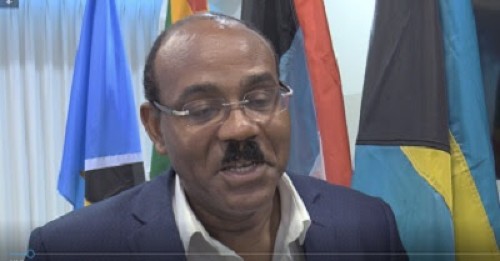 Prime Minister Gaston BrowneBrowne, speaking on his weekly radio programme here, said he had recently participated in an international conference where the issue of debt given that it reduces the amount of fiscal space to fund socio-economic development.
He said many countries are caught up in a “vicious cycle” having to continuously borrow funds to deal with climate-related damages, such as hurricanes on an annual basis.
“ So we’ve said to them that, look, we have contributed a little to this crisis, I mean we have a negligible carbon footprint or negligible fossil fuel uses, so we have said to the footprint or negligible fossil fuel uses, so we have said to them that those who pollute must pay and they’re the ones who should be helping with recovery.
“So we have called upon them to ensure that the loss and damage fund that was established just about a year or two ago, that it should be properly capitalised so that we can get some form of grant funding whenever we get hit by a hurricane in order to make funding accessible to assist with recovery, rather than have to have these countries in this vicious cycle, borrowing cycle, and then they criticise you afterwards and say your debt to GDP(gross domestic product) is too high”.
Browne told radio listeners that it is the developed countries “profligate use of fossil fuels that would have created the condition for these impactful storms which then force us to borrow.
“And I’ve said to them, you know, whenever a hurricane devastates our respective countries in the Caribbean, we can’t go and tell our people that the money that we’re going to borrow, we can’t get tho percent interest or one per cent interest, you know, wherever the money comes from, be it short-term or long-term.
“Well, we don’t get long-term, but if it’s short-term, no matter how high the interest is, you need the money to recover. So we can’t use excuses and say that because we’re not getting long-term money at a low interest that we can’t fix whatever problems, damage the infrastructure, damage the homes, etc.”
Last week, the Executive Director of the Fund for Responding to Loss and Damage (FRLD), Ibrahima Cheikh Diong, said that Caribbean Community (CARICOM) countries susceptible to natural disasters, can expect a speedy disbursement of grant financing from a recently-launched multilateral funding agency.
Diong told the Caribbean Media Corporation (CMC) that CARICOM and other SIDS will benefit from the initiative as they prepare to face another active Atlantic hurricane season that officially starts in June.
Diong said that it is even more critical for an urgent response to requests from vulnerable countries in light of the pending hurricane period.
The Fund recently launched its US$250 million package of early interventions under the Barbados Implementation Modalities (BIM), a pivotal moment for developing countries most vulnerable to the adverse effects of climate change. Diong urged Caribbean countries to submit their priority areas before the June 15 deadline.
“An important innovation also in the early intervention, is that a minimum 50 per cent is dedicated to the SIDS and LDCs (lesser developed countries) recognizing how vulnerable they are.
“So, the idea is that June 15 is the cut off date, unless our board decides to extend the deadline. We go to July, I believe to the end of July, for our next board meeting which ones access support,” Diong said.
Browne said that during the international meeting he recently attended he would have point out the inequities amid calls by the more developed countries for a “more just financial system”
Browne said he would have served as the co-chair of a United Nations expert group, to develop the Multi-Dimensional Vulnerability Index (MVI) which he described as “a fairer metric. “It looks at the vulnerability of a country compared to the GNI (Gross national income) per capita…So in the case of Antigua and Barbuda, they keep saying our GNI is too high,” he said, adding “as far as they’re concerned, we’re a wealthy state.
“But the GNI is backward-looking because when a hurricane devastates the economy, there’s no GNI to talk about. There’s no economic activity. Everything comes to a halt. But when you look at vulnerability, the fact that we are susceptible to these storms and that we have limited capacity in terms of population size, limited financial resources, that is a better measure to determine eligibility. ”
Browne said that Antigua and Barbuda and SIDS continue to push for that and “I would say that Global Citizen has been a good partner as well, providing us with a platform to reach a lot of people, to push for the operationalisation of the MVI, especially by the international financial institutions, the IMF, as well as the World Bank”.
Browne said also that Antigua and Barbuda has working moving away from fossil fuel saying “as it stands right now, when you look at what is happening in Iran, we have a situation now in which we do not get a tax currently from the diesel, and the gasoline, and jet fuels, and so on, that are sold here in Antigua and Barbuda.
“In fact, we are paying to subsidise prices at the pump, and we are also paying to subsidise electricity,” he said, adding that St. John’s , for example, is working towards having “access to geothermal energy, and we are now in serious discussions with St. Kitts and Nevis to work with them to develop their geothermal capacity”.
He said the idea is to run a line from Nevis to Antigua, “so we’ll have base load power, and it’ll be cheaper”
Browne said Dominica, St. Vincent and the Grenadines are also exploring geothermal energy and that he has already “in advanced discussions now with St. Kitts and Nevis and the European Union.
“The European Union is thinking about advancing some funds, a few hundred million US dollars to St. Kitts and Nevis to help them to develop the geothermal project …and we have said to the European Union that we will buy the power from St. Kitts and Nevis to ensure that it’s commercially viable,” Browne added.

