


Derek Ramsamooj Awarded US$30,000 in Compensation Following Unlawful Detention in Suriname
PORT OF SPAIN, Trinidad – The Caribbean Court of Justice (CCJ) Monday awarded the Trinidad-based political analyst and consultant, Derek Ramsamooj, US$30,000 in damages resulting from his arrest and detention in Suriname in 2020.
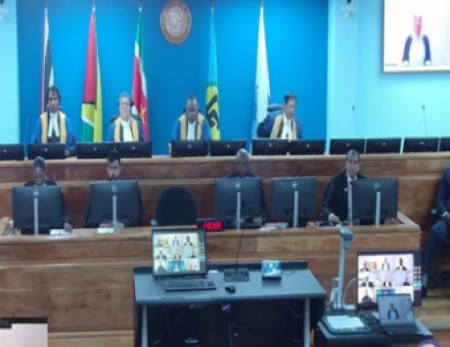 CCJ President, Justice Winston Anderson (second from left) delivering the ruling in the case between political analyst Derek Ramsamooj and the state of Suriname (CMC Photo)Ramsamooj had alleged that his rights under the Revised Treaty of Chaguaramas (RTC) which governs the regional integration movement, CARICOM, had been breached due to his unlawful detention by police officers in Suriname from October 2020 to September 2022.
He said he had also been denied legal counsel and medical attention and that he had also coerced into signing documents in Dutch, a language unknown to him, which were later used in court as his confession.
CCJ President, Justice Winston Anderson, who read the summary of the ruling, said that regarding remedies, the CCJ declined to make a declaration in respect of the alleged breach of the freedom to provide services being unsatisfied on the evidence that Ramsamooj was at the material time actively engaged in the provision of services within the meaning of the RTC.
He said with respect to the claim for damages, the Court was also not satisfied that Ramsamooj had demonstrated a causal link between the denial of his access to counsel and the medical expenses he had incurred.
“Nevertheless, the Court was convinced that the claimant suffered severe emotional and physical distress and that his health deteriorated appreciably because of his detention and that these effects were exacerbated by the claimant being held incommunicado without access to his family and his attorney at crucial stages.
“The Court accepted the unchallenged expert evidence on behalf of the claimant of a consultant cardiologist that the claimant had sustained a coronary event, a stroke, and significant progression of his coronary artery disease during his detention and that the reported conditions of detention would certainly have contributed to the decline of his cardiovascular and general health.”
Justice Anderson said that on the basis of that evidence, the CCJ found that such deterioration in health, “at least partially caused by conditions which breached his basic human rights enjoyed under the RTC, must attract some monetary recompense.
“The Court did not consider it necessary to pronounce on the allegations of breach of Article 7 or 9 of the treaty, noting that a finding of breach of the specific substantive right to freedom of movement was sufficient.
“The Court declared that the application of the Biperkin mechanism to the claimant in the circumstances of this case was inconsistent with and constituted a breach of his right to freedom of movement under the RTC. It awarded the claimant the sum of US$30,000 by way of non-pecuniary damages as compensation for the clear and significant injury sustained by the claimant as a result of the serious breach of an important RTC right”.
The CCJ, which heard the matter in its Original Jurisdiction allowing it to serve as an international tribunal interpreting the RTC, ruled further that “any reliance upon or use in any criminal proceedings against the claimant of any admission or confession obtained from him during the period of his unlawful detention arising from the treaty-inconsistent application of Biperkin would constitute a breach of community law.
“However, this did not preclude the defendant’s state from continuing or instituting criminal proceedings against the claimant on the basis of evidence, if any, obtained independently of and untainted by the unlawful detention or deprivation of procedural safeguards.”
The CCJ awarded costs to the claimant and that “all other applications and claims for relief were dismissed”.
In the 18 minute ruling, Justice Anderson, flanked by three other judges, said that the full written judgement will be available on the Court’s website later on Monday and that the summary “is not intended to serve as a substitute for the reasons of the Caribbean Court of Justice, nor should it be relied upon in any subsequent consideration of the Court’s reasoning”.
The Court heard that Ramsammooj had been visiting Suriname regularly from 2014 and on October 6, 2020, a police officer visited his hotel in Paramaribo, seized his passport and instructed him to report to the police station the following morning.
The next day he was detained in connection with an investigation of alleged fraud by the previous Surinamese government for which he had worked. Ramsamooj was denied direct access to legal counsel for two consecutive eight-day periods on the basis of Biperking orders made under Article 42 of the Suriname Code of Criminal Procedure, (SCCP).
During that time, he was interrogated in Dutch with the use of a translator and signed a statement in Dutch, which was used in court as his confession.
He was held in pretrial detention until 22 December 2020, when he was released due to the deterioration of his health.
The CCJ was told that formal charges of participation in a criminal organisation, fraud, forgery of invoices, and money laundering were laid against him on 26 March 2021, and those charges remain pending before the trial court in Suriname.
Ramsamooj’s passports were held until September 2022, when he was permitted to leave Suriname to eek medical treatment.
With special leave of the CCJ, Ramsamooj instituted proceedings against Suriname, contending that he had been arbitrarily detained in Suriname without access to court or to counsel.
He argued that this amounted to a violation of his rights under the RTC, the freedom of movement, and to provide services. He said also that the rights accorded to community nationals under the RTC are not effective without the protection of fundamental human rights, specifically those rights articulated in the Charter of Civil Society for the Caribbean Community, the Charter, and that the Biperkin provision under the SCCP, or its use in practise, was incompatible with the RTC.
But Suriname contended that the claimant had failed to premise the alleged breach of his rights to freedom of movement and to provide services on discriminatory treatment on the ground of nationality only, that the Charter was nonbinding, and that the court lacked jurisdiction over alleged human rights violations simplicita.
Suriname also asserted that the restrictions imposed on Ramsamooj, including the restriction on his access to counsel, were justified under the RTC for the protection of public morals and the maintenance of public order and safety.
Justice Anderson said that the CCJ had identified four key issues for determination.
The first was whether there is a minimum standard of human rights required for the effective exercise by CARICOM nationals of their rights under the RTC, such as the right to freedom of movement and the right to provide services.
The second issue being if there is such a minimum human rights standard under Community law, whether the operation of the Biperking mechanism under Article 42 of the SCCP in the circumstances of this case was consistent with the effective exercise of the claimant’s right to freedom of movement and to provide services.
The third key issue is whether Suriname could rely on Article 2261A of the RTC to justify its use of the Biperking mechanism with the fourth issue being what remedies were to be awarded to Ramsamooj for any violations of his rights under the RTC.
Justice Anderson said that on the first issue, the CCJ held that Community law imposes minimum human rights standards that must attend the exercise by CARICOM nationals of their treaty-based rights.
He said applying the principle of effectiveness, the CCJ reasoned that the guarantees of free movement of CARICOM nationals under the RTC “would be deprived of their effectiveness if minimum human rights standards were not inferred.
“The Court concluded that the Charter is neither a treaty nor a decision of the Conference of Heads of Governments with Binding Force. Nevertheless, the Charter has legal relevance in the Community’s legal order, first as an aid to the interpretation of the RTC pursuant to Article 31 of the Vienna Convention on the Law of Treaties, and second, in helping to identify general principles of Community law.”
Justice Anderson said that the CCJ found that fundamental human rights are general principles widely accepted throughout CARICOM, evident from the protection of fundamental rights and freedoms of the individual under the constitutions of all CARICOM member states, from the Charter itself and from international human rights instruments such as the International Covenant on Civil and Political Rights and the Universal Declaration of Human Rights to which CARICOM member states had subscribed.
“The Court held that the minimum human rights standards that must attend the exercise of treaty-based rights, such as rights to freedom of movement, include the right of an accused person to have access to legal counsel of his or her choice. That right was entrenched in the constitutions of every CARICOM member state and had crystallised into a regional customary standard.”
Justice Anderson said that on the second issue, the CCJ identified three critical junctures at which the operation of the Biperkin under Article 40 of the SCCP results in the accused being deprived of access to a lawyer, one, during police or judicial interrogation, two, during any challenge to the Biperkin order itself, and three, during the contest of the lawfulness or continuation of detention.
He said noting that Suriname had inherited its criminal procedural framework from the Netherlands during the colonial period, the CCJ contrasted the Surinamese approach with the Dutch system, which had been significantly reformed to require prompt judicial oversight and the immediate provision of an independent alternative lawyer where a suspect’s chosen counsel is restricted, reflecting the position at the European Union level that access to counsel must be effected and effective from the first interrogation.
“Applying the reasoning of the European Court of Human Rights in Sardouz against Turkey, which identifies early and effective access to counsel as a structural safeguard without which the fairness of the proceedings is presumptively compromised, the Court held that Article 40 of the SCCP, insofar as it authorises the deprivation of access to counsel at the investigative stage without compensatory framework sufficient to preserve the effectiveness of the defence, unlawfully impedes free movement and cannot be reconciled with a minimum human rights baseline required by community law.
“The Court found that in those circumstances, there is no need to establish discriminatory treatment on the ground of nationality only in order to establish a violation of RTC rights.”
Justice Anderson said on the third issue, the CCJ reaffirmed a principle in Gilbert against State of Barbados that freedom of movement under the RTC does not immunise CARICOM nationals from the operation of law enforcement agencies in the receiving state, but distinguished Gilbert on the basis that it concerned the application to a Community national of domestic law which was consistent with the RTC.
“The present case fell within the Mariline of authority, where the domestic law authorising the enforcement action is itself inconsistent with the treaty by breaching the minimum standard of human rights.
“Article 226 of the RTC has a greatly diminished role to play. Only in extremely rare circumstances could a member state be permitted to rely on Article 226 to justify conduct that undermines the substance of treaty-based rights by reference to domestic procedures that fail to meet the minimum standards of human rights required by Community law.”

