


KINGSTON, Jamaica - The President of Ghana John Dramani Mahama says the consequences of the transatlantic slave trade and racialised chattel enslavement of Africans did not end with emancipation.
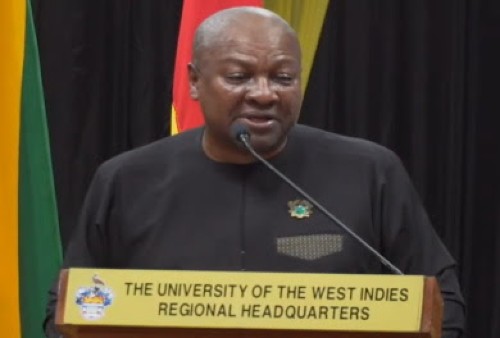 President of Ghana John Dramani Mahama addressing the “Special High-Level Reparation Dialogue” at the Mona campus of the University of the West Indies (UWI) (CMC Photo)He told a “Special High-Level Reparation Dialogue” at the Mona campus of the University of the West Indies (UWI) that the inequalities created by slavery and colonialism continue to shape the patterns of wealth, opportunity, development, representation, and access across the global system.
“It’s therefore important to underscore that the global discourse on reparations has reached a defining moment. The international community is increasingly moving beyond simple acknowledgement of historical wrongs towards structured engagements on how their enduring consequences can be addressed.
“The central question before us is no longer whether historical injustice has occurred. History has already rendered that verdict in the UN General Assembly resolution. The question now is how those injustices and their continuing effects should be addressed in a meaningful, sustainable, and forward-looking manner”
Mahama, who is winding up an official visit to Jamaica participating in the country’s Emancipation and Independence co
“It’s about addressing the continuing consequences of that past. It is about correcting structural imbalances that continue to influence contemporary inequalities. It’s about truth-telling. It’s about healing. It’s about taking accountability. It’s about restoration of dignity and the creation of a more just and equitable global order,” he told the audience urging closer collaboration between Africa and the Caribbean on the issue of reparation.
“Our goal is to ensure that rigorous scholarship, credible evidence, strong institutions, and effective multilateral engagement support the reparations agenda,” he said, adding that no discussion of reparative justice can occur without acknowledging the extraordinary leadership of the Caribbean.
“For decades, Caribbean governments, academic, civil society leaders, and advocacy organisations have remained at the forefront of this movement,” he said, noting that the work of the CARICOM Reparations Commission and the CARICOM 10-Point Plan have provided intellectual clarity, strategic direction, and a principled framework for advancing discourse internationally.
He praised the work of Professor Sir Hilary Beckles, the chairman of the CARICOM Reparations Commission (CRC) and the UWI Vice-Chancellor as well as those whose scholarship and advocacy have helped shape contemporary thinking on reparatory justice.
“Africa recognises and values your leadership. Today, the convergence of African and Caribbean perspectives presents a historic opportunity to us. Together, we can build a unified and credible global position based on our shared history, our shared values, and our shared aspirations.”
The Ghanian head of state said that African-Caribbean collaboration must therefore continue to expand across several fronts, including coordinated advocacy in multilateral institutions, joint historical and legal research, academic exchange and knowledge production as well as cultural cooperation and heritage restoration.
In addition he is calling for cooperation in diplomatic engagements, youth engagement and civic movement mobilisation and development partnerships rooted in mutual respect and shared prosperity.
“Strengthening our partnership will enhance visibility, legitimacy, influence, and momentum for reparatory justice worldwide. The expectation of Africans and people of African descent continues to grow.”
Mahama said across Africa, the Caribbean, America, Europe, and beyond, there is an increasing call for action, accountability, and measurable progress.
“Our responsibility is therefore clear. We must translate dialogue into concrete outcomes. We must develop credible implementation mechanisms, explore sustainable financing approaches, and strengthen legal and institutional frameworks,” he said, adding “we must ensure that engagement remains constructive, practical, and inclusive”.
The Ghanian President said meeting these expectations will require political will, sustained commitment, intellectual leadership, and collective resolve.
“History cannot be undone, but its consequences can be addressed. The injuries of the past cannot be erased, but justice can help to heal them. And through deliberate, coordinated, principled action, we can help create conditions for a more equitable future,” President Mahama told the audience.

