


UNITED NATIONS – President Irfaan Ali Thursday all but blanked a call from the Acting Venezuelan President Delcy Rodriquez for a negotiated settlement to its border dispute between the two neighbouring country.
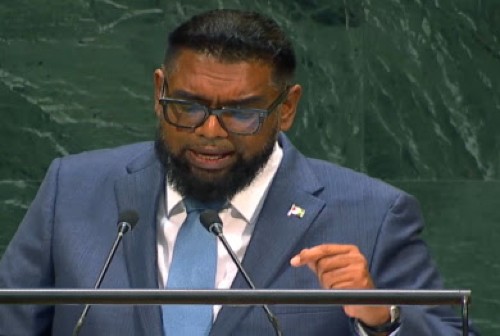 President Irfaan Ali addressing the 81st session of the United Nations General Assembly (UNGA)The International Court of Justice’s (ICJ) is expected to provide a ruling on the validity of the 1899 Arbitral Tribunal Award that settled the land boundary between Guyana and Venezuela, and in her address to the 81st session of the United Nations General Assembly (UNGA), Rodriquez told the global community that she favours a negotiated settlement.
Guyana brought the case before the ICJ in 2018, seeking affirmation that the 1899 Arbitral Award, establishing the boundary between the two countries, is legally valid. The award had been accepted for over 60 years before Venezuela declared it null in 1962 and revived its claim to the territory.
The matter is being addressed under the 1966 Geneva Agreement, which outlines mechanisms for a peaceful settlement. After bilateral efforts failed, the dispute was referred to the ICJ by the United Nations (UN) secretary-general.
The Essequibo region comprises roughly the western two-thirds of Guyana, spanning 61,600 square miles. It is a resource-rich region bordered by the Essequibo River to the east and Venezuela to the west, which Venezuela claims as its own.
Venezuela has in the past linked Guyana’s decision to approach the court with major offshore oil discoveries made in 2015, alleging that Guyana abandoned negotiations after oil reserves were found offshore in territory internationally recognised as Guyanese.
Rodriquez wearing a brooch that includes the Essequibo region as part of Venezuela’s map, said she was making her appeal at the UN, the “very headquarters of international law” and that Caracas desired to reaffirm its rights over the Essequibo region which is two-thirds of Guyana’s 83,000 square miles.
“Here, I appeal to the Cooperative Republic of Guyana to resolve the issue and to return to negotiations, as stipulated by the Geneva Agreement. Agreements which last the longest are those that emerge from bilateral negotiations. They last longer and function better than those imposed by external bodies,” she said.
But in his address to the UNGA, President Ali said Guyana has always advanced the peaceful settlement of the controversy in relation to its border with Venezuela.
“Despite the historical truth clearly outlined in the Arbitral Award of 1899 that determined the full, perfect, and final settlement of our border with Venezuela, we endured long and repeated provocations and aggression.
“The matter was referred to the International Court of Justice by the Secretary-General, acting pursuant to the Geneva Agreement, and the Court twice pronounced on its jurisdiction to hear the matter.”
Ali said that records to the ICJ came after decades of efforts to resolve the controversy bilaterally, including through a mixed commission and the good offices of the UN Secretary-General.
“In full respect for international law, Guyana participated and encouraged Venezuela to participate in the proceedings of the ICJ. Now that we have both participated in the hearings, which were completed in May 2026, we urge Venezuela to abide by the forthcoming ruling in accordance with their obligation under the UN Charter, as Guyana will do.
“We look forward to a new era of neighbourly relations in the interests of our peoples, the development of our countries, and the stability and prosperity of our region,” Ali told the UNGA.
In his wide-ranging speech, President Ali said that the world does not need more sophisticated instruments of destruction and that it needs a more sophisticated capacity for peace.
“In this regard, I reiterate Guyana’s call for a just and lasting solution to the crisis in the Middle East, one that brings an end to the suffering of innocent civilians and recognises the Palestinian people’s legitimate right to self-determination and to secure homeland of their own,” he said, reiterating Georgetown’s “support for a two-state solution.
“We call as well for an end to the Russian-Ukraine war and the war in Sudan and for peaceful resolution of all conflicts that continue to consume lives, uproot families, and extinguish the hopes of millions in other parts of our world.
“We reiterate our call for a viable solution for Cuba, one that is peaceful, people-centred, development-focused, and allows for the full aspiration of the Cuban people to be realised,” Ali said reiterating the Caribbean Community’s (CARICOM) offer to “play a meaningful role in achieving this objective”.
He said with regards to the situation in Haiti, where criminal gangs have been seeking to topple the government ever since the assassination of President Jovenel Moise in July 2021, President Ali said “resolving the multidimensional challenges remains central to achieving democracy, stability, peace, and prosperity for the Haitian people.
“The sustained support of the international community through the provision of key financial and material resources is critical to realising these objectives. Ultimately, the future of Haiti must be Haitian-led and Haitian-owned,” Ali said.
President Ali said that a changing global environment also makes it imperative for the United Nations to remain humanity’s surest hope for a “just and peaceful world”.
He said the global border must have the courage to confront aggression and the will to engage fully with the defining question of the current environment.
He said he is also urging that the UN must be bold enough to undertake the institutional reforms necessary to strengthen the organisation, enhance its credibility, and enable it to meet the challenges of a changing world.
“Indeed, I am pleased that the theme of this year’s Assembly, and I quote, restoring trust, managing transformation, a United Nations that delivers for all, end of quote, acknowledges the need for this organisation to be fit for purpose, to respond to the challenges, and to seize the possibilities of our time.
“Today, we confront a climate catastrophe, an energy crisis, food insecurity, biodiversity loss, armed conflicts, and geopolitical tensions, the horror of genocide, a spiralling cost of living crisis, a mountain death crisis, widening inequalities within and among nations, and perhaps most troubling of all, a weakening of multilateralism itself.”
Ali said that if “history has taught us anything, it is that even when the world seemed to stand at a precipice, humanity has never been entirely without the means to draw it back from the brink.
“We have ended wars that seem without end. We have confronted economic calamities that threaten the foundations of societies. We have overcome dangers that presented existential threats time and again.
“It has been our inventiveness, our courage, and above all, our willingness to act together that have opened a path where none seemed to exist. This is why I do not wish to linger or lament further upon the difficulties before us”.
Ali said that for within every crisis lies a summons to solutions, within every disruption, an opportunity for renewal, and within every uncertainty, the possibility of shaping a better future.
“The possibilities before us are immense,” he told the global community.

