


PORT AU PRINCE, Haiti – One of the five persons who had earlier this year signed a resolution seeking the removal of Prime Mister Alix Didier Fils-Aimé from office, is now distancing himself from an attempt to remove the President of the Presidential Transitional Council (CPT), Laurent Saint-Cyr.
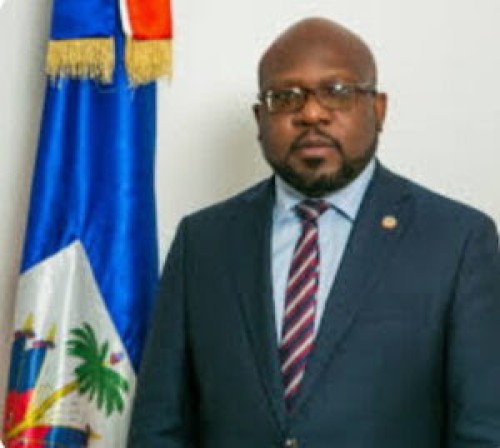 Smith Augustin (File Photo)The mandate of the CPT ends on February 7, this year in accordance with the provisions of the Agreement of April 3rd, 2024.
Last week, a resolution for Fils-Aimé’s dismissal had the support of five members of the CPT, before advisor, Smith Augustin, finally reversed his decision and refused to sign.
Last Friday, two CPT members, Leslie Voltaire and Edgard Leblanc Fils, told a news conference that they intend to proceed with a plan to remove Prime Minister Fils-Aime within 30 days following established procedures, despite United States warnings that such a move would have consequences.
The move to remove Saint-Cyr, who is also the coordinator of the Transitional Council, follows allegations that he failed publish the removal resolution in the official journal, Le Moniteur.
But Augustin, in a letter to his colleagues, said he would not sign a new resolution aimed at removing Saint-Cyr.
In his January 29 letter, Augustin said he wanted to “formally and unequivocally” clarify his position regarding the proposed removal of Saint-Cyr, “just days before the end of our term”.
He said that following the recommendations stemming from discussions held with several national stakeholders within the framework of the political dialogue on January 18, “we considered the dismissal of the Prime Minister, Mr. Alix Didier Fils-Aimé.
”I supported this initiative, convinced that our presidential prerogatives gave us the necessary latitude and believing that such a decision could facilitate the institutional transition starting February 7, 2026. I acted in good faith and with full responsibility.
”However, it must be acknowledged that this decision has deeply divided the Council, contributing to the worsening of the political crisis and creating tensions with certain international partners, notably the United States Government, which has expressed its support for the Prime Minister in a clear and unusual manner.”
He said he has since noticed efforts to remove Saint-Cyr and replace him with “a new coordinator tasked with submitting the resolution concerning the Prime Minister’s dismissal to the Official Journal of the Republic.
“With all due respect, I must express my opposition to this approach,” Augustin wrote, adding “it seems to me, in fact, difficult to defend, from a legal standpoint, that an unpublished resolution could have the effect of repealing a previously published resolution, particularly the one establishing the duration and allocation of responsibilities for coordinating the rotating presidency.”.
He said even assuming that some people consider this approach “legally sound, there is clearly no consensus on its legality.
”Furthermore, if this procedure were to be initiated without the agreement of the coordinator in question, what would the concrete consequences be?
“ In the event of a persistent refusal to publish the official gazette, should we consider successive dismissals: first of the Secretary General, appointed by published presidential decree, and then possibly of the Director General of the National Press, himself appointed by the Council of Ministers ? Wouldn’t such a course of action risk triggering an uncontrollable institutional spiral, just days before the end of our mission?”
Augustin said that he remains “deeply convinced that this path is neither the most responsible nor the most appropriate for concluding our mandate, in a context already marked by significant internal tensions and extreme institutional fragility.
“I remain certain that the Haitian people expect from us greater restraint, institutional rigor, a sense of duty to the state, and a commitment to transcending political divisions.
”Therefore, I am informing you that from today until February 7, 2026, I will refrain from participating in any similar decision-making process, which I perceive not as a clear-headed and consensual search for a way out of the crisis, but as an institutional escalation with unpredictable consequences,” Augustin wrote.
Earlier this week, the 15-member Caribbean Community (CARICOM) grouping said that it has noted “with great concern” the “internal turmoil” taking place in its member state, Haiti, and urged “stakeholders to put the future of their people and country above all else”.
CARICOM said that the internal turmoil was taking place “at this delicate point in time when stability and level-headedness in decision-making, and prioritisation of the well-being of the Haitian people, are urgently required of members of the Haitian executive”.
CARICOM said the current impasse within the CPT, following the inconclusive efforts of some members to dismiss the Prime Minister, renders more complex an already fraught governance transition process.
“Meanwhile, the people of Haiti continue to suffer unimaginable violence and deprivation.
“This is unacceptable. It is crucial that stakeholders put aside differences to reach consensus. The CARICOM Eminent Persons Group (RPG) remains at the disposal of all stakeholders to facilitate agreement from the multiplicity of proposals which currently exist,” CARICOM said.

