


BRIDGETOWN, Barbados – In the run up to this month’s general election, Prime Minister Mia Mottley has pledged cost-of-living relief through targeted cash credits and tax measures if re-elected.
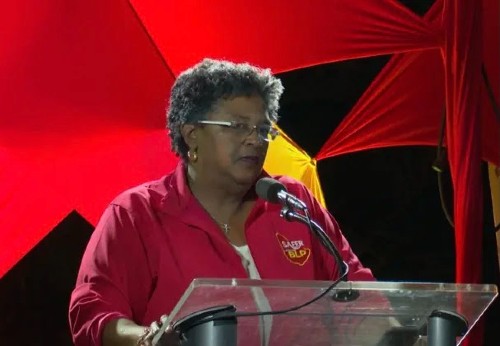 Speaking during a meeting of the governor Barbados Labour Party (BLP) late Saturday, Mottley also rejected broad value-added tax (VAT) cuts it says may not translate into lower prices.
Addressing supporters during the launch of the party’s manifesto, Mottley argued that VAT reductions offered no guarantee of relief for the most vulnerable.
“Everybody deserves the money back in their pockets and not with some arbitrary reduction of VAT that you don’t know whether the man will reduce the prices in the shops or not or the services,” she said.
Mottley however said the party had opted for what she described as creative and responsible solutions, building on measures implemented since taking office in 2018.
She recalled that when the BLP returned to office in 2019, the reverse tax credit stood at $650 and was available only to those earning $1 500 a month or less.
Mottley also announced a new reverse tax credit of $750 for people earning between $2 080 and $2 900 a month, roughly $25 000 to $35 000 a year, a group that previously did not qualify.
Turning to proposals by the main opposition Democratic Labour Party (DLP) to reduce VAT, Mottley issued a sharp warning.
“Ralph tells you about giving you back and carrying VAT to 15 per cent but when the VAT goes back down to 15 per cent, first of all, he ain’t tell you how much it’s going to cost. Then secondly, he ain’t tell you that you ain’t getting back that money from the merchants. When you see merchants carry up prices, you ever seen them come back down? They don’t come back down. But the difference between this government and that (DLP) is that we will put the money back in your pockets at the end of the year.”
For those earning between $35 000 and $50 000 a year, Mottley said a compensatory income credit would ensure that any income tax paid during the year would be fully refunded, once the country could afford it.
She illustrated the measure by noting that a person earning $4 000 a month, or $48 000 a year, currently paid $2 875 in income tax.
“You will now get back all of that money at the end of the year,” she said.
Mottley also outlined new measures for pensioners and the most vulnerable, noting that the tax-free allowance for pensioners had already been increased from $45 000 to $50 000 last year.
“Tonight, I am announcing that if we come back into office, that tax-free allowance will be increased to $75 000 for pensioners in this country,” she said.
However, she acknowledged that some pensioners, welfare recipients and people receiving special needs grants would not benefit from tax changes because their incomes fell below the threshold.
To address this, she announced a new cost-of-living cash credit.
“We will give every pensioner, contributory and non-contributory, every welfare recipient and every recipient of a special needs grant, adult or child, $1 200 a year,” she said, explaining that the payment could be taken monthly, quarterly, half-yearly or as a lump sum at the end of the year.
Mottley stressed that these measures were no “idle promises” and said the approach was preferable to VAT reductions.
In recent weeks, several parties contesting the February 11 general election, most notably the opposition, have proposed VAT cuts as a means of easing consumer pressures.
The Central Bank of Barbados has cautioned against wholesale VAT reductions, with Governor Dr Kevin Greenidge warning on Wednesday that such measures could undermine fiscal stability, increase debt pressures and fail to deliver meaningful benefits to households, particularly the most vulnerable.
Professor Troy Lorde, a university dean and acting director of the Shridath Ramphal Centre, also warned that while VAT cuts may be politically attractive, a targeted, evidence-based approach would better protect vulnerable households, preserve fiscal balance and support Barbados’s wider economic competitiveness.
Referencing those warnings, Mottley accused the opposition of failing to explain the fiscal impact of its promises and added that the measures reflected a government that had listened to public concerns.
“This government is putting money back into your pockets immediately and that is what is going to make the difference. I have heard you on the cost of living, and we recognise that we are in a position now to give you something back.”

