


GEORGETOWN, Guyana – Guyana's government Monday night outlined a raft of socio-economic policies that it said are geared towards prioritising investments that directly promote economic growth, accelerate the transformation of the country, enhance human capital, and improve social wellbeing.
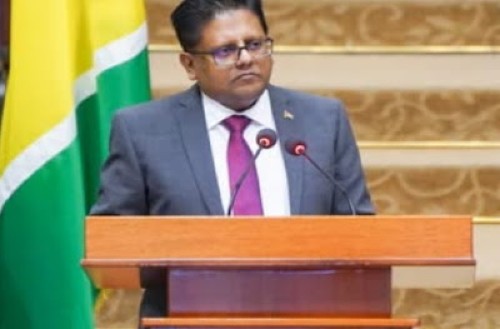 Finance Minister Dr. Ashni Singh delivering the 2026 national budget to the National Assembly on Monday night (CMC Photo)Finance Minister Dr. Ashni Singh delivering the first budget of the ruling People’s Progressive Party/Civic (PPP/C) since it won last September’s regional and general election, told Parliament that the Central Government total expenditure is projected to grow by 15.8 per cent this year, to reach GUY$1.5 trillion (One Guyana dollar=US$0.004 cents), with the Public Sector Investment Programme (PSIP) expanding to GUy$779.6 billion, and non-interest current expenditure to GUY$705.1 billion.
He told legislators that the PSIP continues to be the engine delivering the Irfaan Ali government’s national transformation agenda, pushing deeper into the foundations of daily life by building modern roads and bridges, new and upgraded energy infrastructure, world class schools and hospitals, affordable housing and safer communities.
He said this year’s national budget Budget is crafted so as to give effect to President Ali’s vision for a modern, prosperous Guyana, that provides opportunities for every single Guyanese person.
He said the fiscal package is 12.7 per cent larger than the previous budget, totaling GUY$1.558 trillion, “the largest budget ever, and is financed with no new taxes”.
Singh said that total receipts of public enterprises are expected to increase to GUY$296.4 billion in 2026, while total expenditure of public enterprises is projected to grow by GUY$83.2 billion, with operating costs estimated to grow from $196 billion last year to $210.5 billion this year.
He said capital expenditure is projected to increase by GUY$68.2 billion when compared with 2025 and as a result, the overall surplus of public enterprises is forecasted at six billion Guyana dollars this year.
The Finance Minister regarding the operations of the non-financial public sector, a deficit of GUY$442.9 billion, or 7.6 per cent of gross domestic product (GDP), is projected.
“The budget before this Honourable House therefore prioritises investments that directly promote economic growth, accelerate the transformation of our country, enhance human capital, and improve social wellbeing.
“ It supports an education and training system that equips our children and young people with relevant skills for a modern, diversified economy; a health system that is more accessible, resilient, and responsive; and social protection mechanisms that provide dignity, security, and support for the most vulnerable among us.
“These are not expenditures of convenience, they are investments in productivity, resilience, and a better Guyana, a Guyana where all can prosper, and a Guyana where ability and effort are rewarded. As I said before, this is the Guyana we are building,” Singh said.
The government said that in alignment with its objective to support the accumulation of savings and assets by individuals, it will remove the net property tax on individuals, which will increase the disposable income of these persons by over GUY$1.4 billion and that the measure is applicable from year of assessment 2026
In addition Singh said that by the end of its last term in office, the government doubled the income tax threshold from GUY$65,000 in 2020 to GUY$130,000 in 2025, resulting in GUY$18 billion in disposable income to all workers and the removal of 60,000 persons from the tax net.
“I now wish to announce a further increase of the threshold to GUY$140,000 monthly, with effect from year of income 2026. This will result in the removal of 5,000 persons from the tax net whilst adding over two billion dollars in disposable income to workers”.
Singh said that these measures will provide over GUY$100 billion to citizens, not including the impact of the removal of the excise tax on fuel, to promote economic activity, job creation, and increase disposable income to the Guyanese people.
He said that as part of the government’s ongoing efforts to accelerate economic diversification, it will designate a number of areas as special development zones that will benefit from fiscal incentives.
“This initiative complements government’s wider push to enhance the competitiveness of the manufacturing sector, including the impending reduction in the cost of electricity, which will significantly lower production costs and improve the viability of large-scale and export-oriented manufacturing operations.
“these locations will be identified based on a strategy to promote geographically balanced development taking into account proximity to raw materials and connectivity to domestic markets. This approach is intended to incentivise higher levels of private investments in strategic locations.”
Singh said that with keeping with the country’s food security agenda, the government will remove the corporate taxes on agriculture and agro-processing businesses and that this will increase retained earnings and enable greater investments to boost production and productivity.
He said in support of the forestry value added subsector, the government will expand the list of products eligible for export allowance to include timber value added products.
“This will enhance the competitiveness of qualifying exporters and lower their effective costs by reducing their tax payable, thereby allowing them to price their goods more competitively in international markets. This measure is intended to incentivise value added production”
Singh said that to increase competitiveness of the forestry sector, lower cost of construction, and support local manufacturers, government will remove the value added tax (VAT) on locally made furniture including doors, moulding, and beds.
“This will boost our local industries on their path to sustainability and competing regionally,” he said, adding that VAT will also be removed on locally produced jewellery.
The government also intends to remove the residency requirements for destination weddings as Guyana seeks to position itself as a niche tourism market.
“Government will remove the 14 days residency requirement for destination weddings. This measure is expected to expand tourism-related economic activity to the benefit of the hospitality industry.”
The government is also removing duty and VAT on security equipment with Singh saying that it is in “alignment with our agenda of building safer communities and to augment our national efforts to combat crime.
“This will, at the community level, enhance crime deterrents and detection, bolster situational awareness and enhance collaboration between our citizens and the Guyana Police Force to allow for swift identification of incidents and response time”.
Singh said that the establishment of the Guyana Development Bank will greatly assist small and medium enterprises (SMEs) that play a critical role in creating employment opportunities and supporting community-based economic development.
He said in recognition of the need to expand access to finance, the budget allocates US$100 million to be injected into the Guyana Development Bank which will provide SMEs, young entrepreneurs, women, and persons living with disabilities, with access up to three million dollars in micro-credit loans at zero interest, with zero collateral requirement for targeted investments in specified sectors.
“A key aspect of this programme is that loans will be paired with mentorship and training to support the growth and development of the SMEs,” he said, noting that the government will embrace a co-investment model, effectively sharing the financial risks, providing support so that SMEs may be able to access up to an additional seven million dollars at preferential interest rates from participating commercial banks.
“Government will extend to the commercial banks similar fiscal concessions as are granted for low-income housing. This forms part of a wider initiative to strengthen the ecosystem for SME growth in Guyana.”
Singh said that since 2020, the government has made significant progress on improving access to adequate housing and reducing the cost of home ownership.
“Building on this progress, over the next five years, our target is to ensure every Guyanese family has access to affordable housing. It would be recalled that over the last term, we increased the low-income mortgage ceiling at commercial banks from eight million dollars to GUY$20 million. I now wish to announce a further increase in the low-income mortgage ceiling from GUY$20 million to GUY$30 million, which will make housing loans at commercial bank more affordable to borrowers.”
He also announced that a low-income mortgage ceiling window of GUY$30 million will also be extended to approved insurance companies that offer housing loans under similar arrangements that apply to commercial banks.
The Finance Minister in his presentation also announced plans to provide funding to help homeowners improve on their buildings, reduce the cost of vehicles, outboard engines, as well as continue with the zero per cent excise tax on petroleum products.
Singh said that to cushion the impact of rising international shipping costs the government will maintain the decision reverting freight charges to pre-pandemic levels for the calculation of import taxes.
Among the the fiscal measure outlined by the Finance Minister are the increase in the Because We Care (BWC) student grant to GUY$60,000 benefiting 206,000 children in public and private schools, the introduction of an annual transportation support grant for school children as well as ensuring that students have “equitable access” to Caribbean Examination Council (CXC) exams.
Singh said that there would also be an increase in old age pension, the introduction of annual transportation support grant for pensioners as well as increase in public assistance.
Support for the elderly and child care are also included in the national budget this year with Singh telling legislators “all who live in Guyana, our aim is that you must be able to live in comfortable, safe, and modern communities”.

