


Violence Remains Focus as Haiti Election Hopes Persist
PANAMA CITY, Panama – There was cautious optimism regarding Haiti’s long-delayed elections at the 56th Regular Session of the Organization of American States (OAS) in Panama, but regional leaders stressed that restoring security remains the country’s most urgent priority.
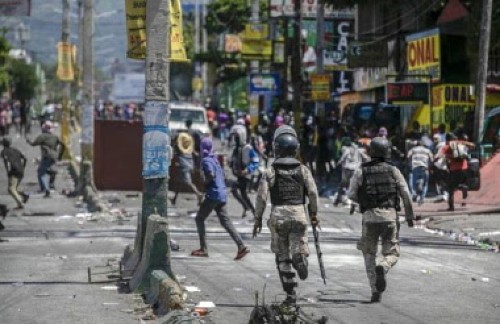 Unrest in Haiti (File Photo)Caribbean Community (CARICOM) Assistant Secretary-General for Foreign and Community Relations, Elizabeth Solomon, told the Caribbean Media Corporation (CMC) that the regional organisation continues “to work with all national and international stakeholders towards stability and transformation of Haiti, including through ensuring security to pave the way to elections.”
According to Solomon, CARICOM has been supporting the embattled Interim Government “in bringing the security situation under control by playing a significant role within the Standing Group of Partners that oversees the (multinational) Gang Suppression Force (GSF).”
The emphasis on defeating armed gangs was reinforced when OAS member states unanimously adopted a resolution supporting a Haiti-led stabilisation strategy.
This calls for stronger regional coordination to combat gang violence, curb illicit arms trafficking, strengthen the Haitian National Police, and expand international support for the GSF.
The resolution also urges member states to increase financial and technical assistance while backing long-term efforts to reduce violence, dismantle criminal networks and address the social conditions that fuel instability.
OAS Secretary-General Albert Ramdin said that “Haiti requires hemispheric solidarity first and foremost.”
He cited active OAS support for the GSF, the establishment of a Special Mission, and the appointment of Special Representative Alberto Fohrig.
Through the OAS Universal Civil Identity Programme in the Americas (PUICA), Ramdin said, “we are supporting Haiti’s Identification Office, where in the last months alone we distributed more than 600,000 identification cards, which are critical for the holding of elections in the Republic of Haiti.”
The last electoral register placed Haiti’s electorate at 5.85 million in 2015. With the country’s population now estimated at about 12 million, the number of eligible voters is believed to be around six million.
The OAS resolution meanwhile stresses that elections alone will not restore stability. It calls for an inclusive Haitian-led political consensus, continued humanitarian assistance, stronger institutions, and sustained international support to create conditions for free and fair elections in a secure environment while respecting Haiti’s sovereignty.
Solomon said CARICOM would continue working alongside the OAS and the United Nations on the OAS Roadmap for Stability and Peace, as well as with the Association of Caribbean States, which has been supporting humanitarian initiatives in Haiti.
Addressing the Assembly, Haiti’s Ambassador to the OAS, Joshue Pierre, described free and fair elections as essential to meeting the expectations of the Haitian people, while cautioning that all international assistance should remain aligned with priorities determined by Haitians themselves.
Haitian Foreign Minister Raina Forbin briefed ministers and senior officials on the country’s political and security situation after earlier consultations with a Caricom delegation.
Haiti has not held presidential elections since the 2021 assassination of President Jovenel Moïse. A CARICOM-inspired transitional arrangement was established in 2024 to facilitate elections, but these have yet to take place.

