


FREETOWN, Sierra Leone - Barbados Prime Minister Mia Mottley has reiterated a call for closer collaboration with Africa as developing countries seek to cope with a changing global environment.
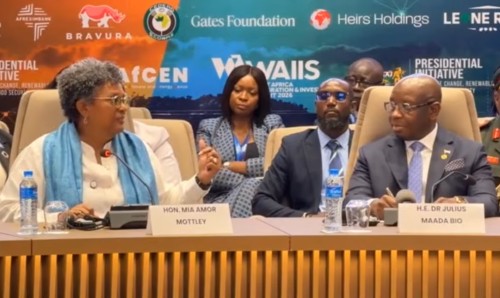 Barbados Prime Minister Mia Mottley, flanked by Sierra Leonean President, Julius Maada Bio., addressing the inaugural West Africa Integration and Investment Summit (WAIIS 2026) (CMC Photo)Addressing the inaugural West Africa Integration and Investment Summit (WAIIS 2026), which ends here on Wednesday, Mottley told delegates that the international financial institutions are reluctant to provide easier financing mechanisms to help African and Caribbean regions deal with high debt and other situation.
She said in October last year, she participates in meetings with the World Bank, the International Monetary Fund (IMF) the International Development Fund and a number of other financial institutions from the Arab cooperation group in a bid “to shape the trajectory of international finance.
“And we asked this question, because for too many of our countries that are hungry, we do not have inventory of being able to access finance that matches the life of the assets, and that makes it an impossible scenario,” Mottley told the delegates including Sierra Leonean President, Julius Maada Bio.
The two-day event is intended to drive regional integration and investment and provide the platform to turn that potential into bankable projects, strategic partnerships and measurable economic outcome.
The organisers said that with a combined gross domestic product (GDP) exceeding US$600 billion and a market of more than 450 million people, the region is positioned to become one of the world’s fastest-growing investment destinations.
“…Against that backdrop, what we’re trying to do is to simply match finance, the life of the asset to the finance in which we are paying. And as you heard, in June of this year in Yemen, in a very short period of time, we were able to reach an agreement on the principles of the vulnerability to viability compact. “
She said that those four principles are “very, very clear,” noting that “as we seek to have this compact, we focus on loans for education, for water, and for health.
“We’re not trying to boil the ocean. We’re trying to be strategic, and we know that in these three areas, everyone needs to see progress ,” Mottley said, noting that developing countries “have argued that, one, we must have a longer term, more concessional funding”.
She said that the reality is that domain funded, frontier funded, with a 10 and a half year monitoring comes not from a development finance institution but from the IMF whose responsibility relates to balance of payments and monetary policy to be able to establish economic stability.
“We think that if the IMF can afford to do that for countries across the world to build resilience, then the development finance institutions should be able to give longer term funding, not 20 years, but 40 and 50 year funding.
“And secondly, that if the IMF can make it possible to recognise the importance of increased periods of 10 and a half years, then we need people to recognise in the development finance institutions that increased periods should probably be between 15 and 20 years.”
Mottley said the long-term funding was necessary, giving as an example the construction of a school “the children from those who are at school will have to come up, will have to go to university before they start to learn.
“If we have a grace period that is sufficiently long, it means that those people who benefit from that investment are also then able to use it to help repay for that investment. It is the same thing with hospitals. It is the same thing with water mains,” she added.
Mottley said that it was also necessary for the Caribbean and Africa to mobilise funding for their own development, noting that “ the reality is Africa has four trillion US dollars in savings, of which US$600 million is pension funds.
“… we hope to be able to see over the course of the near future the establishment of the = Pan-African Market Bond Initiative, and we feel so strongly about it,” Mottley said, noting that rather than the Caribbean focussing only on a regional capital securities market in the Caribbean which is going to be miniscule.
“…we need to find ways to see how we can work together to be able to ensure that the mobilisation of private savings can be done at scale and, quite frankly, to be able to be directed to good projects across Africa, in the diaspora, particularly in the Caribbean, so that we have opportunities for investment and we can have the ability to bring returns.
“There is no reason why Caribbean capital cannot equally be involved in the provision of the biggest problem that Africa has to solve, which is the provision of energy and electrification to its population.”
Mottley said that without access to energy, without access to legal rights, “we cannot move on to the next level.
“And we equally have a considerable amount of savings in the region. We’ve always been told don’t put your eggs all in one basket and therefore diversification is critical if we’re going to see a lot of opportunities for the Caribbean.
“It does mean that we have to find ways of de-risking. In some instances, it may mean taking first loss. In other instances, it may mean finding ways to deal with currency hedging. But that is what we’ve got to bring this stuff to the table to be able to do as well, not just to provide only access to funds in normal, general sense.”
Mottley said that there is also need for there to be rules to have natural disaster clauses and pandemic clauses “just as you had to face a huge disaster which led to the loss of so many lives, you will have to move your bill.
“But if you can’t move your bill because you don’t have access to money, because you’re paying debt that was previously collected, you then are in trouble,” Mottley said, recalling the experiences of some Caribbean countries that had to find money to pay for back loans within two weeks.
“But it was the same debt they were trying to find money to feed people, to secure people, and to provide shelters for people. It is immoral. And therefore, the natural disaster clauses are all of what you will.
“They’re cause clauses, they’re resilience clauses. You know, they have a way of giving names, new names to everything. But what matters is that the principle exists that if you have a sufficient, powerful event, dramatic event, we are in a position in Barbados to be able to put on pause for two years all of our payments of debt, interest, and principle.
“It goes to the back end of the loans. But what it does for us, it releases the equivalent of about 18 per cent of GDP over two years. Now, anybody who can give you that level of loan is almost a concierge, and I can assure you that there is no country, there is no company, there is no institution who will give us that.
“But this simple legal provision in the contract, give it to the lender because he knows that he will ultimately pay, rather than say, what’s going to happen? Are we going to get our money? He knows ahead of time that he will pay.
“And secondly, you as a government get the elbow grease that is needed to meet people where they are at the most perilous and difficult time,” Mottley said noting that there is need to work with the recently launched initiative for small island states.
“And we’re working on them to be able to see that they should not be available only to small island states. They should be available to all vulnerable countries. And we carry that baton, but we need your voices.”
Mottley said that while Barbados has been told that the international capital markets will never accept these pandemic clauses and these natural disaster clauses, Bridgetown recently went to the international markets last year June for more than US$500 million for availability management.
“Not only did we get what we wanted, we had bids that were six times what we asked for, and we got everything that we wanted at a cheaper interest rate than countries that had better regulations.
“But most importantly, we got that money with natural disaster clauses and with pandemic clauses. Now, what is the pandemic clause equivalent? Then, effectively, if you are capable of showing that there is a pandemic that has been certified by the World Health Organization, the threshold is very high by the World Health Organization, and that you are likely to face damage in more than 10 per cent of GDP, then you can put that clause.
“Similarly, with respect to the hurricanes or the other climatic events, there are certain metrics that we use,” Mottley added.

