


BVI Not Seeking Free Movement Within CARICOM
BASSETERRE, ST. Kitts - The British Virgin Islands (BVI) will not allow the free movement of Caribbean nationals if it is accepted as a full member of the Caribbean Community (CARICOM) grouping, Premier Dr. Natalio Wheatley has said.
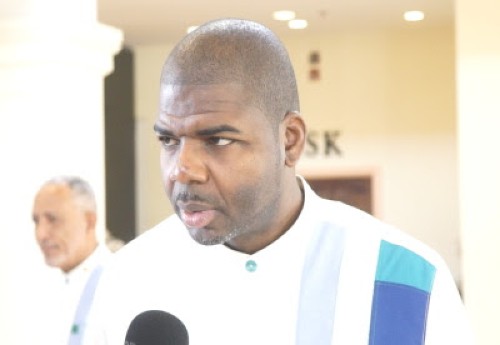 Premier Dr. Natalio WheatleyHe told the Caribbean Media Corporation (CMC) on Thursday that he is hoping to further advance his British Overseas Territory’s application for full membership at the ongoing Caribbean Community (CARICOM) 50th regular summit that ends here on Friday.
The BVI, along with Turks and Caicos Islands, Anguilla and Bermuda are seeking to advance their associate membership in the 15-member CARICOM grouping, with Bermuda already getting the green light from the United Kingdom.
However, Bermuda has said that it will not accept the issue of freedom of movement under the CARICOM Single Market and Economy (CSME) citing its small size and inability to support open borders.
Montserrat as a founding member of CARICOM, is the only Associated State with full membership within the grouping.
The CARICOM leaders have travelled to Nevis for their retreat on Thursday and prior to their departure, Wheatley said the BVI has “great support” from among the regional leaders with regards to its move to advance its status within CARICOM.
“Bermuda has put forward their application, the BVI has also put forward our application and of course the Turks and Caicos Islands will follow closely behind and we are hopeful that we will become full members very soon.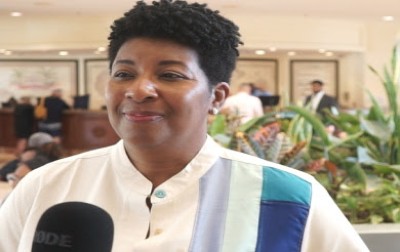 Premier Cora Richardson-Hodge (CMC Photo)
“But there is a process that has to be undertaken. The process has begun,” he said, noting that discussions have been taking place with senior CARICOM Secretariat officials “and thus far things have been going very well…and we expect to see a good outcome very soon”.
Weatley said on the issue of free movement, the “people of the associate territories, the associate members of CARICOM must understand that the situation is going to be different for those territories who are under differing administrative powers.
“In our case the United Kingdom and so full membership for us will look different than it looks for an independent sovereign country and even the independent sovereign countries not all of them have signed up to the freedom of movement and freedom of movement will be one of the areas that we will not sign up too.
“Most of the other areas we will be able to participate in it fully, but because we are not an independent sovereign country, freedom of movement, security and certain aspects of foreign policy are not within our gift to be able to make decisions on within the community”.
Wheatley said that the BVI was also seeking full membership within the sub-regional Organisation of Eastern Caribbean States (OECS) “but it will be a similar position within the OECS.
“We don’t anticipate having freedom of movement and I don’t think all the members of the OECS will have freedom of movement. I think the freedom of the movement is something we will have to look at carefully because while we may favour it from an ideological standpoint we have to ensure that some of the smaller countries, territories where persons may want to come to, and to be able to work and not overwhelm because we have finite and limited resources”.
He said the BVI for instance, over 70 per cent of the work force is from outside “so we already have freedom of movement to some extent.
Meanwhile, Anguilla’s Premier Cora Richardson-Hodge told CMC that the Associated States are “looking for more than just being observers at the CARICOM Summit”.
“It is important that we all feel as part of one body. We are all members of CARICOM and by virtue of our constitutional status being Overseas Territories, we are unable to participate to the full extent over the years”
She said that the various overseas territories are looking to change that and looking to increase and improve the levels of collaboration and their ability to work even closer with the other independent countries.
“And so I am satisfied. I think that a lot of work has gone into it. Some of the Associated Members have gone quite a distance in terms of obtaining legal advice, negotiating with the powers that be to be able to ensure that they can achieve full member status,” said Richardson-Hodge, who is celebrating her first year in office having been sworn in on February 27 last year.
“And so I fully support the steps that are being taken and we will get there,” she said, noting also that on the question of free movement of people that in Anguilla’s context, “we have not applied and so at this point in time, I’m not aware as to what the requirements are, what the steps are, what steps have been taken in order to be able to be a part of that aspect.
“But worst case scenario, I would imagine that there are some carve-outs because ultimately, especially as it relates to overseas territories, if there is a limitation by the powers that be in terms of the free movement of people, I’m sure that we can work through that process.”
Richardson-Hodge said that for instance, persons, they may not be through the process of free movement,” but it could be by way of work permits, and work permits are freely given in the Associated Member territories.
“And so there’s always a way to work around whatever limitations there may be. And so I’m satisfied that we can overcome whatever issues there are”.
Asked whether she has a period in mind when the application for full membership could be made, Richardson-Hodge said in Anguilla’s context, “this is the first time that I am becoming fully aware of all of the steps that are taken since being elected.
“In actual fact, today makes a one-year anniversary of my government being in office. And so coming into CARICOM, listening to what the other Associated Members who have already started that process, it is a good thing. And I support it. And I do believe that Anguilla will go in that direction at some point in time as well,” she added.

