


SANTO DOMINGO, Dominican Republic – The Caribbean Community (ARICOM) Secretary general, Dr. Carla Barnett says regional integration must now be viewed as a strategic development platform to drive economic transformation, enhance resilience, and advance the Caribbean’s strategic participation in an increasingly uncertain, complex, and competitive global economy.
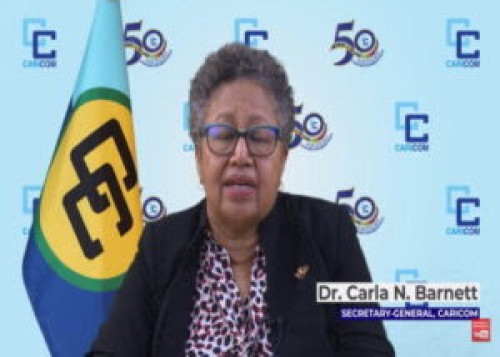 Barnett said that this could be achieved through increased investment and broadening of economic and trade relations.
“Traditionally, regional integration has been viewed primarily as a vehicle for market enlargement, trade liberalisation, and functional cooperation among a grouping of states,” she told a panel discussion at the 41st session of the Economic Commission on Latin America and the Caribbean (ECLAC) taking place here.
Barnett said that however, as small states navigating a global environment characterised by geopolitical uncertainty, technological disruption, climate change and increasing competition for investment and productive capabilities, the 15-member regional integration grouping has been focusing on the strategic re-design of it integration project.
“Emphasis is now placed on deepening the CARICOM Single Market and Economy (CSME) through prioritisation of more results-based sectoral integration, aimed at building regional economic security and beneficial insertion into engagement with the global economy.”
Barnett told the panel that recent global crises have elevated food security to a strategic component of a reimagined CARICOM integration agenda.
“Our regional ambition to reduce the region’s food import dependence, as set out in Vision 25 by 2025 plus 5, goes beyond an agricultural initiative to represent a regional development and resilience strategy,” she said, adding that CARICOM has prioritised strengthening cooperation in agricultural production, research and development, climate-smart agriculture, sanitary and phytosanitary systems, logistics, and agricultural technology.
She said that the opportunities presented by precision agriculture, digital technologies, biotechnology, and climate-resilient farming practices can be accelerated through regional cooperation, shared investment, and knowledge exchange.
Barnett said that energy security must remain an overarching goal of regional cooperation, while it continues to play a pivotal role in supporting more competitive production across the Community, including through renewable energy investment and greater energy efficiency.
“A forward-looking integration agenda should deepen regional collaboration and cooperation in areas such as renewable energy deployment, energy efficiency standards, regulatory harmonisation, energy investment frameworks, and climate financing.
“Collective action is needed to accelerate the transition to cleaner and more affordable energy systems while reducing external dependence and enhancing energy security. This is a strategic imperative for industrial development, productivity growth, international competitiveness, and economic resilience.”
Barnett said that the imperative to achieve food security must be supported by efficient and affordable transportation, which is treated as strategic regional infrastructure and an essential enabler of trade, investment, tourism, labour mobility, and productive development.
She said that the emphasis is therefore on building an integrated Caribbean transport and logistics ecosystem, connecting maritime shipping, air services, ports and airports, inland infrastructure, logistics services, and digital trade facilitation.
“Better transportation would enable Caribbean producers to source inputs regionally, reach neighbouring markets more efficiently, and participate more effectively in wider Latin American and global value chains.”
The Belizean-born economist acknowledged that the economies of Caribbean countries remain highly exposed to external shocks and overly dependent on a limited range of economic activities.
She said non-fuel overall merchandise trade deficits continue to expand year on year noting “. CARICOM regional integration must, therefore, support the emergence of competitive regional value chains, greater industrial capacity, and deeper economic diversification and innovative industries capable of competing in an increasingly complex global economy.
“We have to move beyond integrating markets towards building regional productive capabilities to strengthen competitiveness, generate quality employment and reduce our vulnerability to external shocks.”
Barnett said equally important is ensuring that CARICOM’s financial architecture can effectively support cross-border economic activity.
She said that this requires the establishment of agile, interoperable regional payment systems, strengthened credit enhancement and risk-sharing mechanisms, and more coordinated approaches to development finance.
“We envision a regional financial ecosystem that enables businesses, particularly micro, small, and medium-sized enterprises, to access finance, conduct cross-border transactions, and expand within the regional market.
“At the same time, strengthening the Community’s capacity to mobilise financing for climate adaptation, resilient infrastructure, and productive transformation remains essential to advancing resilience, competitiveness, and sustainable development.”
Barnett said building regional productive capabilities requires a more coordinated approach to industrial policy, investment promotion, infrastructure development, and the establishment of competitive regional value chains.
She said that the CARICOM Industrial Policy, that was recently approved by regional leaders, provides an important framework for advancing the objective of identifying opportunities for member states to develop complementary rather than competitive productive capabilities.
“We are targeting areas such as agro-processing, green manufacturing, pharmaceuticals, creative industries, digital services, and logistics.
“By pooling markets, resources, skills, and investment promotion efforts, CARICOM can create economies of scale to successfully integrate, compete, or even defend its industries against other international blocs that no individual Member State can achieve on its own.”
The CARICOM Secretary General said that digital transformation and artificial intelligence offer significant opportunities to enhance productivity, reduce transaction costs, expand market access, and strengthen public institutions.
But she said realising these benefits, however, requires strategic investment in digital infrastructure, enabling regulatory frameworks, institutional capacity, and digital skills. “CARICOM has prioritised a more integrated regional digital economy, through enhanced cooperation on digital infrastructure, interoperable platforms, cybersecurity, data governance, and skills development.
“It is specifically recognised that leveraging artificial intelligence and other emerging technologies could improve productivity and innovation across key sectors, including agriculture, manufacturing, financial modernisation and productive transformation. Ultimately, digital transformation has been characterised as a strategic instrument for economic modernisation, productive transformation, and deeper regional integration.”
CARICOM has adopted a protocol on Enhanced Cooperation, which provides a framework for some member states to move ahead to implement agreed initiatives while other member states can commence implementation when they are ready and able to.
Barnett said that the operationalisation of this protocol is already evident in a regional arrangement among four member states to implement full free movement of people, which entered into force on 1 October 2025.
“This initiative has important implications for building productive capabilities across CARICOM by enabling a more efficient allocation of human capital across the member states involved,” Barnett told the panel discussion.

