


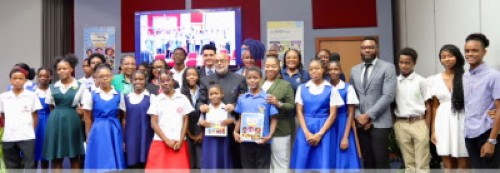
CASTRIES, St. Lucia - The Organisation of Eastern Caribbean States (OECS) Commission has officially unveiled the OECS Regional Child Policy and Strategic Plan 2026-2032, signaling a transformative step forward in strengthening the sub region’s commitment to safeguarding and advancing the rights, development and well-being of children.
 The project is being undertaken with the support of United Nations Children’s Fund (UNICEF).
The ST. Lucia-based OECS Commission said that the OECS Regional Child Policy and Strategic Plan 2026-2032 draws on insights gathered directly from stakeholders, parents and children.
It said adopting a comprehensive whole-of-the-child approach, it provides a structured framework to ensure that every child is protected and that children’s interests are prioritised. Built on evidence rather than assumptions, its vision is “By 2032, every child in the OECS will feel valued, safe, supported, loved and empowered, while enjoying the full range of their rights, regardless of gender, disability, migration status, or background.”
OECS Director General, Dr Didacus Jules, said that the true measure of the policy’s success will not lie in the document itself, but in how meaningful it is translated into meaningful action that improves the lives of children.
“A child does not live inside a document. A child lives in a home, on a street, in a village. A child wakes up in the morning, eats- or does not eat- walks to school, sits in a classroom, plays in a yard, scrolls on a phone, visits a clinic when sick, and goes to sleep at night either feeling safe or feeling afraid.
“Every one of those moments is where this policy must live. Not on paper. In life. So what we are launching today is not a document. It is a promise, and more than a promise, it is a plan of action.
“A connected cluster of practical initiatives, working together across health, education, justice, protection and social support to build something our grandmothers understood long before any of us wrote a strategy: a whole community wrapped around a child,” Jules said.
Head of the Human and Social Division at the OECS Commission, Mrs Sisera Simon, highlighted the policy’s guiding principles, which include prioritising the best interests of every child, ensuring non-discrimination, listening to children’s perspectives, safeguarding their mental well-being and embedding strict accountability at every level of governance.
“To the children and families of the OECS, we accept this responsibility with the utmost gravity and enthusiasm. We will not allow this blueprint to gather dust on a shelf. We will live it, track it, and enforce it.
“By 2032, it is our collective mandate to ensure that no child in our region is left unseen, unprotected, or unloved. This is our promise, and this is our commitment,” she added.
UNICEF’s Representative in the Eastern Caribbean, Maryam Abdu, framed her remarks around a story of a little girl named Aaliyah, whose hopes and aspirations represent the promise inherent in every child.
“Today is about ensuring that every child like Aaliyah- whether in Antigua and Barbuda, Dominica, Grenada, Saint Lucia, Saint Vincent and the Grenadines, Saint Kitts and Nevis, Montserrat, Anguilla, or the British Virgin Islands- has the opportunity to survive, thrive, learn, participate, and reach their full potential.
“The launch of the OECS Regional Child Policy 2026-2032 is more than a milestone. It is a regional commitment to move from shared concern to coordinated action for every child across the Eastern Caribbean.”
The OECS Commission said that the launch of the project reflects the sub-region’s enduring commitment to creating safe, inclusive and protective environments for children.
It said aligned with the OECS’s strategic imperatives, it provides a practical framework for embedding child protection and empowerment across the region.

