


CASTRIES, ST. Lucia – A senior official of the International Organization for Migration (IOM), Patrice Quesada, Monday said that Caribbean countries need to develop policies that will assist them deal with a decline in their populations.
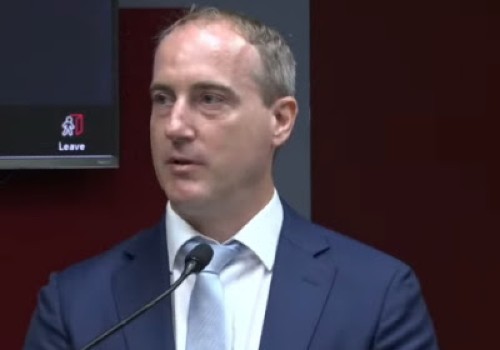 Coordinator for the IOM Caribbean Office, Patrice Quesada, addressing the launch of the St. Lucia Draft National Gender-Sensitive Migration Policy on Monday (CMC Photo)Addressing the launch of the St. Lucia Draft National Gender-Sensitive Migration Policy, the coordinator for the IOM Caribbean Office, said that the event marks a significant milestone in migration governance for the island as well as the wider Caribbean region.
Quesada said that the IOM is providing the methodology to bring everyone around the table, to provide the capacity building that was required to ensure that everyone understood and used the terminology in the same way, understood the issues that were there, exposed to the legal frameworks that they might not be aware because they work in health and not in education.
He said the objective is to look at resilience, protection as well as the dignity of everyone in St. Lucia, including foreigners.
“It’s to look at sustainable development while at the same time embracing the changes that are to come. And the changes and challenges that are facing the Caribbean are numerous,” he said, noting that climate change and natural disasters, are drivers of mobility and migration, as seen in neighbouring islands like in Dominica.
But he said what is more worrisome now, is the issue of demographic decline.
“This is something that the Caribbean is experiencing very strongly, and that has far-reaching consequences, especially in the mid-term, but especially when you start looking at longer-term trends.
“In the case of Saint Lucia, what is very interesting is that right now, as you are probably very well aware, in terms of demographic, we are facing more or less slightly above zero per cent population growth, which means that it’s currently reaching a plateau.
“But the reality is that fertility rates are already below 1.4 per cent. The replacement rate to ensure that there is continuous growth of population is 2.1 percent. So while the figure of growth is plateauing, the understanding is that the decline in terms of demographic will start.
“St. Lucia is probably in a better position than some other Caribbean countries, sister islands that are already experiencing this decline, like in Barbados…where there is already a net loss of population year after year.”
Quesada said being ready with a migration policy that can be part of the solution is extremely important, because demographic decline means an ageing population.
“It means investing in an industry of care. It also means that you would have less workers and more retirees, pensioners and from a fiscal perspective, it poses a lot of challenges. And this is not just for the Caribbean. This is really across the Caribbean space.”
He said he wanted to flag another important element , which is how much this conversation that you have here can also inspire the rest of the Caribbean.
“I’m saying that because we all face similar challenges, especially when it comes to demographic decline or the impact of climate change and a lot of solutions cannot just be national solutions.
“They will have to be regional solutions, by pulling resources together, by pulling ideas and solutions together. On the side of the International Organization for Migration, this is the reason why we’ve also been supporting, since 2022, the CARICOM Secretariat with the development of the CARICOM Regional Migration Policy Framework, which is currently under consideration by the competent Council of Ministers.”
Quesada said that has been part also of an extensive process to ensure that priorities for all the member states of the Caribbean could be put together into a policy that could help the regional institution to cope with the challenges to come, but also to size any opportunities around migration.
He said that there are many, remittances being one of them.
“Diaspora engagement and return is another one. Labour migration to fill gaps in sectors that are under tension is another one. There are plenty of solutions, but also challenges that need to be looked at from a social protection perspective and others, security perspective, as we are mentioning.
“That’s also important to bring the CARICOM prospect, because one of the reasons why we were so keen on supporting St. Lucia to develop its national migration policy was precisely to give an example to the rest of the CARICOM member states on how to do it.”
He said he is particularly grateful and proud that the IOM has been able to support St. Lucia by being the first pilot in the Caribbean region to undertake this national migration policy, inspired by the regional migration policy, by the different areas that “we had collected at the time, to already have a concrete example that other member states can look at and decide to implement as well, to bring the regional migration policy priorities into their national consideration.
Quesada said St. Lucia has been leading the efforts in the Caribbean on showing what developing a migration policy, “that it’s fit for purpose, that it’s forward-looking” even as he acknowledged that a policy is just the beginning of something else “which is the hard part, the implementation”.
He said St. Lucia has been able to come through the extensive level of consultation involving various stakeholders to develop a migration policy that ensures the security of its citizens.
“Because we know that this is an extremely important matter for the citizens of St. Lucia. Security is paramount. But we also know that others have families abroad. Some of you may also be relying on remittances. We understand that the diaspora for St. Lucia represents 12 percent of the population, bringing 2.5 per cent of gross domestic product (GDP) in remittances.
“That’s an important source for many families in this country, and something to build on, something to look at in terms of how can we turn remittances into investment, productive investment for the country.”
He said that those are among the recommendations and provisions included in the draft migration policy.
“We also understand that some employers may be looking for skills that they are not able to find on the local markets, and are looking at the regional market to ensure that the service that they can provide meets the needs of their customers.
“All those perspectives are valid. The question is how do you bring them together, how do you take them into account, how do you look at the trade-off that some of them might be creating.”

