


PORT OF SPAIN, Trinidad – United States Deputy Secretary of State, Christopher Landau, Monday said the re-opening of a steel company here reflects a commitment made by the leaders of the two countries “to stimulate economic growth in each of our respective countries”.
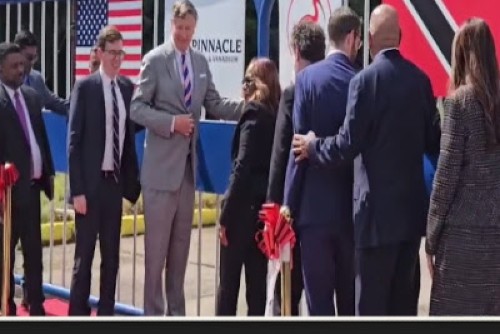 United States Deputy Secretary of State, Christopher Landau (in grey suit) at the ribbon cutting ceremony for the the Ibis Steel Company at Point Lisas in central Trinidad, on the site of the former ArcelorMittal plant, (CMC Photo)Landau, who is expected to hold talks with Prime Minister Kamla Persad-Bissessar, told the ribbon-cutting ceremony for the Ibis Steel Company at Point Lisas in central Trinidad, on the site of the former ArcelorMittal plant, which closed in 2016, that the event represents a new chapter in relations between Trinidad and Tobago and the United States.
“Both President Trump and Prime Minister Persad-Bissessar came into office last year pledging to stimulate economic growth in each of our respective countries, and I think you can see at a place like this that both our countries over the last several decades have faced serious challenges in industrial development and in manufacturing”.
He said both countries have experienced closure of several plants and that both leaders came “ into office pledging to restart industrial economies that had fallen by the wayside.
“That was a promise made to the voters, and that was a promise that both these leaders fully intended to fulfil. These weren’t just going to be words, they’re going to be actions, and so …our mission is to actually take our leader’s vision and transform it into reality”.
Landau said both countries are “free market economies, and so we in the government can’t just direct with the waving a magic wand, well this will now happen.
“In the United States, we did many terrible things over the last several decades, and I don’t know you in Trinidad what your experience is, but in our country we basically destroyed our own mining industry, our own processing industry through excessive environmental regulations, really counterproductive ones.
“Everybody wants a clean and safe environment, but at some point layers of regulation upon regulation don’t really materially help the environment, but they just certainly create a nightmare for people who are trying to run a business.”
He said such difficulties allowed for many US factories to relocate to China “and we saw factories like this shuttered across our country, and now I see it’s not just our country, it’s other parts of the world that face the same thing.
“I think there is nothing more beautiful, frankly, than being able to see a plant like this that’s been shuttered come back to life. It’s like Lazarus arising from the dead again, and this is not just the metal that we’re seeing here, it’s the lives that are impacted”
Ibis Steel Company is a local subsidiary of the US-based Pinnacle Steel and Vanadium Corporation occupying the site of the former ArcelorMittal steel mill that closed in March 2016 due to prolonged financial losses, a crash in global steel prices, mounting debt, and fears over rising domestic electricity and natural gas costs, resulting in the abrupt dismissal of over 600 worker.
Landau said that the Trinidad and Tobago government has spoken “very eloquently” about the 644 jobs, adding “those jobs are coming back, as well as all the many other jobs.
“And that’s a win not only for Trinidad, but also for the United States, because this is one of the things that we lost, then, is not only the jobs, but also the strategic positioning. We let a lot of our critical supply chain completely fall out of our hands, so that we found that if we need certain minerals or other essentials for life, guess what?
“We’re dependent on a foreign country that may not have our best interests at heart. It is a strategic imperative for us as the United States to revitalise these kinds of projects. It’s all about the private sector, ultimately, so I just want to give a huge shout out to Pinnacle for really recognising this opportunity here and for stepping into the breach,” the US Deputy Secretary of State said.
He said he is pleased that Pinnacle has recognised the value of international investments for the good of the American people, adding “mean, this plant is exactly what we’re talking about in diplomacy when I say there are so many win-win situations.
“I mean, we need these critical minerals. You need jobs. You have tailings and industrial residue that’s been left over from 100 years of industrialisation. This is a perfect example of what we’re talking about.
“I mean, that is great for Trinidad. It’s great for the United States, and I’m just really grateful to a company like Pinnacle for stepping into the breach,” he said, praising the private sector for looking for opportunities”.
“I want to, again, thank the government of Trinidad for also recognising that you had a serious company here and coming to the table. I know these were tough negotiations …(and) that this was still in play through last night or maybe even early this morning.”
He said re-opening the plant would be advantageous to the United States that rely on rock and ore that used to produce steel “which goes into our battleships, into our skyscrapers…
“When we’re talking about the strategic imperative of ensuring our critical mineral supply chain, this is exactly what we’re talking about. And so again, it is amazing to be here in Point Lisa’s Trinidad,” Landau said, adding that Prime Minister Persad-Bissesar “has just been an incredible partner”.

