


BRIDGETOWN, Barbados – Prime Minister Mia Mottley says Barbados has completed its economic rehabilitation and is entering a new phase of tourism-driven growth, marked by a surge in hotel development and a strategic shift branded as “Tourism 3.0”.
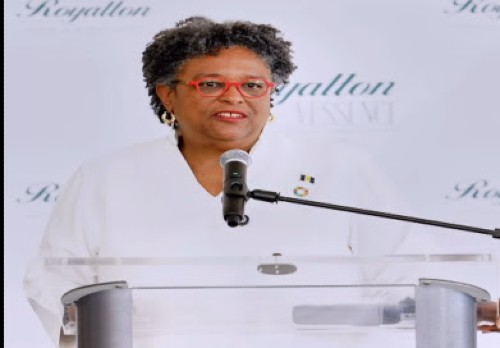 Prime Minister Mia Mottley addressing the ribbon-cutting ceremony for the new Royalton Vessence resort in St James (CMCC Photo)“Put simply, if the body is bleeding, stop the bleeding. When you stop the bleeding, do the transformation, do the operation, and when you finish the operation, get into recuperation, and when you finish recuperating, get into physiotherapy,” Mottley told the ribbon-cutting ceremony for the new Royalton Vessence resort in St James, west of here.
“We are at the point now where we passed the physiotherapy with the opening of this royalty business over the course of the last few months,” she said, descripting the project as an unprecedented wave of tourism development, with a significant expansion of the island’s accommodation and hospitality offerings.
Mottley said that the capital, Bridgetown, is undergoing structural transformation aimed at repositioning it as a major accommodation and hospitality centre for both visitors and resident with 10 hotels either recently completed or under construction.
“When I ask those involved in tourism, what other similar period of time can we reflect on that had this volume of hotels and construction and new product going on, most cannot tell you a comparable period.”
Mottley defended the decision to repurpose existing properties rather than expand inland or rely heavily on land reclamation. She also acknowledged that increasing density remains contentious arguing it is necessary to sustain public services and infrastructure.
“If this country is to finance its way, then it does need in many instances to increase its density, and that the status quo that worked for some will not be able to deliver a good life for the majority.”
Mottley told the ceremony that post-independence development relied heavily on locally owned properties and that the entry of international brands represents a necessary shift, provided national identity is maintained.
“Investment is confidence made concrete but confidence from outside must always be matched by confidence within,” Mottley said in welcoming the new hotel project, adding that it is important that “all inclusive must include Barbados.
“Our farmers, fishers, manufacturers, artists, musicians, entrepreneurs and small businesses must all see themselves in the opportunities that tourism creates. Visitors should leave knowing not only the hotel, but the people, culture and communities that make Barbados unlike anywhere else. A global name should carry a Barbadian story and leave a Barbadian legacy.”
“ What I would love to see going forward, as I said, is an increase in terms of the local purchase. This is what we have done and started to do in a more decisive way with the cruise industry, because Barbados must not just be the place upon which home porting is done, and people get on the ships and leave.”
She said Barbados must be the place where a large part of the procurement, as far as the island can deliver to standard, is done.
“We have had fleeting examples, regrettably, in the history of the Caribbean, where we have had the level of synergy between tourism and agriculture, tourism and manufacturing, tourism and culture, tourism and essentially the essence of the rest of the engine of the economy. ”
She said tourism is a sector that commands effectively a reach of 45 per cent indirectly of the island’s gross domestic product, noting that “in other words, everything that we produce every year, almost one in every two dollars, is related to tourism in some manner, form or fashion.
“Whether it is the drivers delivering product here, whether it is the port workers offloading the product on the docks, whether it is the persons who are doing the artwork for here, whether it is the fresh produce that is bought from here.
“So that this matter of synergies between tourism and the rest of our economy is fundamental in the resetting of what I have come to call Tourism 3.0. COVID made us realise that tourism in Barbados cannot leave out people at the centre.”
Mottley said generally, Barbados has an exciting future and thanked the hotel investors for choosing to be part of the future of the island.
“You have chosen to be part of it. We thank you for that, and we must continue with focus and with purpose, recognising that until such time as we develop new industries, as we must that can reduce the reliance on tourism from one in every two dollars, then tourism is our business. Let us play our part,” Mottley added.

